Background

Tragedy through the eyes of children
Lauri Maijala's two-year period as a director at the Helsinki City Theatre will end on a small stage – the same one in which Maijala decided to become a theatre maker at the age of six.
Read moreBreaking the language barrier
Minttu Mustakallio and Tuukka Leppänen, the great favourites of the Finnish theatre community, will take on a new challenge for the autumn: they will both play the lead role in another Finnish language on the stage of Lilla Teatern.
Read more
“My Day as a Groundhog is a challenging work”
Samuel Harjanne is a musical director whose magnificent performances have been enjoyed on Finland's largest theatre stages. This autumn, the big stage will feature both the hugely successful The Little Mermaid and the musical My Day as a Groundhog .
Read more
The Broadway musical arrives in Lillan
Jakob Höglund, the artistic director of Lilla Teatern and the director of Once, also designs the choreographies for his performances himself.What is the musical Once about?
Read moreHow did the musical come about?
Interview with Danny Rubin (DR), the screenwriter of the musical My Day as a Groundhog, and Tim Minchin (TM), who is responsible for the music and lyrics. Where did you get the idea to make My Day as a Groundhog musical? DR: I've been writing songs and playing guitar since I was a teenager and I've listened to a wide range of things: from folk and rock to chamber music and Broadway musicals. As my career turned to screenwriting, I was looking for ways to sustain music in my life and even worked on a few musical film projects. After the release of My Day as a Groundhog, I knew I had no interest in writing a sequel - for me, My Day as a Groundhog was already a sequel in itself, which made an actual sequel unnecessary. On the other hand, however, I knew that the story would be very rich in themes, and if I had the opportunity to return to the material, I would only do it once and with a different art form than film. I considered writing My Day as a Groundhog novel (each chapter is a chapter 1); television series (the sets and characters are the same in each episode, as is customary in half-hour television comedy series), but by far my best choice was a theatre musical. I realized that the musical narrative gives the story the freedom to include repetition, themes and variations, twists and synchronisations - all musical means that fit perfectly with the groundhog of my day. Even the broad themes of Phil's journey — his changing mind, appearance, and civilization — can be reflected in evolving musical styles. All of this sounded like a great way to get back to the story, and I thought it would be fun. Which it was. What kind of relationship did you have with My Groundhog Day before composing the musical? TM: I had seen the movie more than once, and I loved it... But I wasn't a fan through and through. And actually, "film-to-stage" adaptations are generally not my thing. In any case, my day as a groundhog was a great starting point, which had an unusual structure and I always trusted that it could carry on stage. What kind of challenges were there in bringing the story to the stage? DR: Less than I thought. For example, the film is largely built on montage - short scenes edited together, which allows jumps back and forth in time and space. But how on stage could Phil fall off the clock tower and get out of bed in the next scene? Director Matthew Warchus instructed me that anything I could dream of, I could do on stage. We were able to execute innovative and surprising stage magic in our original stage version, such as an impossible chase scene. I found that my previous years of experience as a screenwriter had prepared me for this endless rewriting and refining of scenes, so my personal challenge: the musical I hesitated to do turned out to be a wonderful experience. One of the expected challenges was easily solved: does the story take place in 1993 or in the present day, as in the film? I wanted it to be set in the present and the only real challenge, the elephant in the room, was that there were no cell phones or wireless networks in 1993. Today, in the event of a sudden weather event, everyone would check their phones and Phil Connors could call anyone or spend his days surfing the internet, which would greatly reduce the feeling of being trapped. Luckily for me, phone and data connections can plausibly be interrupted due to a snowstorm, so this is what happened. I would say that the biggest challenges from the film to the stage are related to the character of Phil Connors. For the majority of the audience, Phil Connors is Bill Murray. In order for My Day as a Groundhog to work in any artistic form, we have to want to go on a trip with the clearly unsympathetic Phil. Bill Murray has a unique ability to be mean and loved at the same time, so he hit the spot in the film. On the other hand, his style in the film is very laconic and expressionless, he is not a man who bursts into song. We could have recreated a Bill Murray-type character who might be too cynical to sing, but at the breaking point, his natural voice would come out. Not a horrible idea, but would mean a musical in which the protagonist only sings at the end. So, in the end, it was better to free the audience from thinking of Bill Murray as Phil and look for new ways to create a nasty person who credibly bursts into song, with whom we are happy to make this long journey.
Read more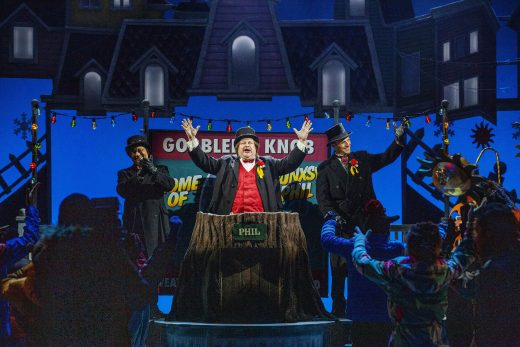
History and festivities of Groundhog Day
Groundhog Day has a long tradition in the United States. The first American mention and a detailed description of the relationship between the groundhog's shadow and the arrival of spring can be found in the diaries of James Morris, a merchant from Pennsylvania, dating back to 1841. The Groundhog Day celebration, which is still celebrated today, has been celebrated in the small village of Punxsutawney since 1887. The originator and father of the tradition of Groundhog Day is considered to be Clymer Freas (1867–1942), a journalist for a local newspaper inPunxsutawney. The tradition is said to have spreadfrom Punxsutawney around the United States and Canada, where Groundhog Day is celebrated annually on February 2. Groundhog Day is considered to stem from a Christian tradition that emerged during the Roman Empire, Candlemas Day. According to the Bible, Mary brought Jesus to the temple at the age of 40 days, and Simeon identified him as the prophesied messiah. The name of the day dates back to the Middle Ages, when candles to be burned in the church during the year were consecrated on that day. Candlemas is associated with the beginning of a brighter time. February 2 is also a significant celebration in Celtic folklore, when the Imbolc festival is celebrated. Imbolc is a celebration of the dawn of spring, when a new beginning and fertility are celebrated. The tradition is associated with the Irish goddess Brigit, the protector of women giving birth. The tradition of seeing one's own shadow, on the other hand, comes from Germany, where the shadow of badgers and other small mammals has been used to predict the beginning of spring. What happens on Groundhog Day? The celebrationin Punxsutawney, which has a population of less than 6,000, is huge; up to 40,000 people gather in Gobler's Knob Parkon the outskirts of the small town before sunrise. During the ceremony, a group of men dressed in shaket clothes lift a marmot named Phil out of a hole made for it, and if Phil sees his shadow on a bright day, he will return to hibernation and the winter will continue for another six weeks. But if the day is cloudy and there is no shadow, spring is declared to arrive early that year. The festivities include speeches, live music and various performances from storytelling to comedy, magic and traditional crafts. The numerous food stalls in the festival area take care of the nutrition of the guests. In Punxsutawney, the marmot is extremely popular and its own association, the Punxsutawney Groundhog Club, has been established. Sources www.history.com/news/groundhog-day-history-and-facts www.goddessandgreenman.co.uk/imbolc-candlemas www.groundhog.org/legend-and-lorewww. wikipedia.org/wiki/Punxsutawney_Phil www.groundhog.org/ www.libraries.wright.edu/community/outofthebox/2015/02/04/groundhog-day-notes/fi.wikipedia.org/wiki/Kynttilänpäivä
Read more