Director’s Word – Fanny and Alexander
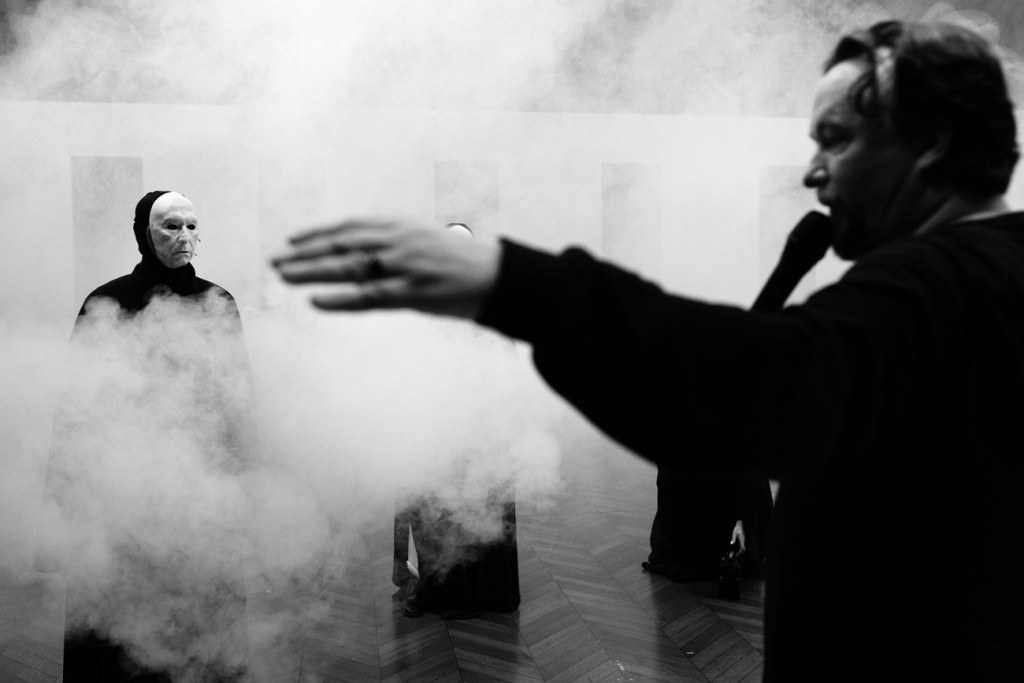
The design process of this work has been unusually long, it started already in the spring of 2018. The global pandemic postponed the premiere planned for 2020 by a couple of years.
During this time, the world has changed a lot, and it has been interesting to see how it has affected the design process of the performance. And it has also been interesting to notice how many of the themes of the performance have taken on new meanings during this time.
Despite its painful themes, Fanny and Alexander is probably Ingmar Bergman’s most hopeful work. It is an epic symphony in which the most important questions of life, the questions of love and death, are dealt with within the framework of family, childhood and theatre.
This work celebrates the existence of theatre, imagination, actors and stage. The world of theatre represented by the Ekdahl family and the world of the church meet in this play. The bishop of the play thinks that theatre people escape reality into stories, and theatre people think that through stories they depict the world and face it.
Ingmar Bergman is undoubtedly one of the key authors of the drama of the last century. His way of describing human psychology is clear and direct. He doesn’t pose, but looks straight into the soul. When it comes to the stage interpretation, it goes without saying that we are separating ourselves from the original work, i.e. the film itself, while still carrying the core of the work with us.
All of us adults have basically survived our childhood. One way or another. Otherwise, we wouldn’t be here. It is often customary to talk about traumas in connection with childhood. For some reason, we may rarely talk about childhood treasures. What are the valuable and enlightening things that have made us what we are now? What is the light that we still carry with us?
A child can be deprived of all freedom and power, but not of imagination, even though Bishop Edvard Vergerus tries to do so in this play.
Fanny and Alexander want to say that the power of imagination is limitless, and if a person focuses more on light than darkness in themselves and others, it is possible for all of us to be saved.
The work was written almost 50 years ago, and Bergman has placed the narrative and events of the text in the early 1900s. In terms of the staging of our performance, we move in time from the beginning of the 1900s to the present day. It is a so-called psychological epoch, which takes a kaleidoscopic gaze into time. The play has wonderful, well-written speeches about theatre, a lot of inner strength and beauty in the text. However, what is very attractive about this story is the similarity of its life. No character is only good or bad, everything has shades.
There are certainly many keys to our interpretation. However, one key could be how our childhood looks when we look back on it. What are the highlights there? How we write the script of our childhood from a new perspective every day, emphasizing what is important to us at that particular moment and what serves us. Let that be our freedom.
I would like to thank the Helsinki City Theatre and all its wonderful staff for all their help, support and trust, as well as for their incredible professionalism. Special thanks to the entire working group of this book for their love and commitment.
What speaks to me in this time is the beauty of this work, which does not avoid pain and the true tones of life, but which reminds us of the incredible power of love and community.
What do we believe in our most difficult moments?
Helsinki, 4.11.2022
Paavo Westerberg