Gravity
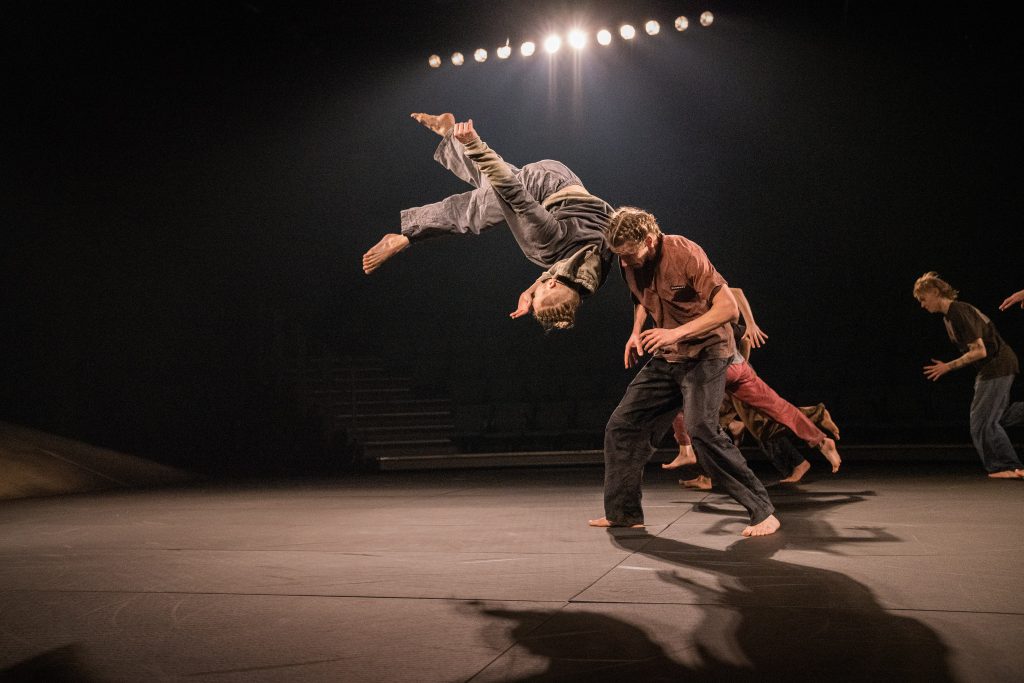
Gravity is designed to be conversational on two levels. My first attempt has been to create a work of art from Gravity that feels like the viewer is falling inside or with the work. Secondly, I wanted to make art that seems to belong to this time.
I feel that it is sometimes boring to build a dance based on the pair technique to be opened straight forward. Mainly because the dancers’ own gaze directions are more towards each other than in the same direction (i.e. together towards the audience). For this reason, it felt good to turn the stage of Gravity into an arena. The surrounding auditorium gives permission to act towards a potential partner or turn things towards the centre of the space, even if it is away from the spectators. In addition to this, it allows the audience to get significantly closer to the dance, without it actually being directed or performed for them.
My attempt to strengthen the experience of being inside the work was not limited to the model of the stage. Gravity’s movement language has been practiced and selected from movement ideas and ready-made techniques that have some kind of natural rhythm built in through both speed and weight. The good thing about the business world, which is built on weight dripping, dropping, spinning and other business ideas based on the continuation of kinetic energy, is that it is possible and easy to empathize with. Its routes can be guessed at times, curves and falls can be seen leading from one movement to another, and their ease and difficulty can be experienced right away.
While I thought I was making a work that should feel sympathetic and impressive to the viewer, I would also like it to be connected to the surrounding time. I tried to make sure that Gravity would not only borrow, but also learn something from its time. Aggressive speed manipulation, stills, stuck jerky movement, dehumanization of dancers and collisions that suddenly stop acceleration were selected as qualitative tools from which we set out to create the spirit of Gravity on top of the above-mentioned crude and big movement ideas. In order for Gravity to boldly look like itself, I thought that in addition to the variety of details and the intensity of the movement material, it should also feel structurally hectic. I try to avoid scenes of more than two minutes, tie things on top of each other and roll motion ideas one after the other. This felt right thematically and was definitely related to the dance content that can be found on social media, for example. At the same time, it is also part of a larger trend of constantly advancing visual cultures, which you can then think all about.
I would also like to thank the entire team for a very successful job, everything has gone smoothly. And not least the great dancers who have done a job very professionally and dedicatedly, which I can only assume was very demanding both mentally and physically.
Jarkko Mandelin