In the strange retro-futuristic world of sea weather, friends cling to each other
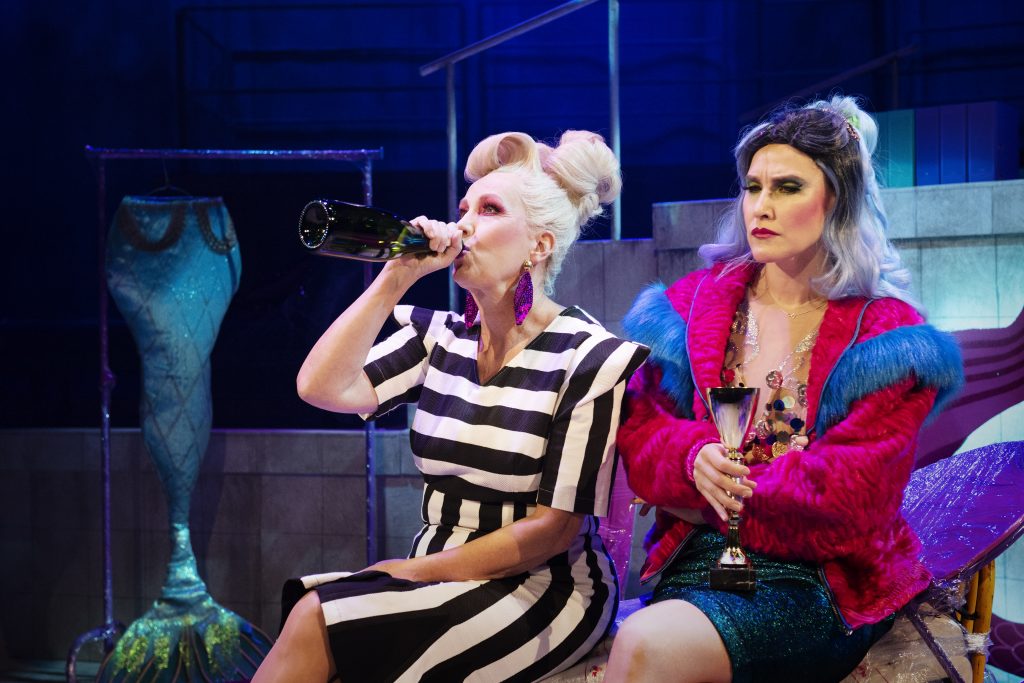
Maija Vilkkumaa’s debut play, Sea Weather, takes the viewer to a world that has become strange, where the streets of southern Helsinki have been washed into the sea. The city, which has been left on water, has forced residents to look for new ways to cope in life.
The play started with a picture that came to Vilkkumaa’s mind, in which a woman is rowing on a rowing machine and another is cheering her on. “Picture by picture, a slightly absurd and retro-futuristic world began to develop,” Vilkkumaa says.
The rowing machine was replaced by a rowing boat, in which the main characters Henna and Matilda transport the townspeople from the Market Square to Tähtitorninmäki. Henna is a well-known face in the public eye and the figurehead of a rowing company, who recites poems while rowing. He is a strange variety artist of the new era and a big star that Matilda has to pamper. Matilda, on the other hand, is a person with a gambling problem who takes care of the company’s money.
Vilkkumaa wanted to write about friends whose roles change with the play. When perspectives in a friendship are reversed, the one who seemed stronger and more effective suddenly turns out to be weaker.
In a foreign world, the importance of friendship is emphasised
While creating the absurd and fantasy-like world of Merisää, Vilkkumaa pondered how humans act in a new, even frightening world, where everything familiar and safe has disappeared.
By examining the dynamics of human relationships, you can get to grips with how and how people find their place in the world. Belonging to a group is a fundamental need: without contact with others, a person has nothing.
Henna and Matilda are trying to make ends meet by creating a new livelihood and starting a rowing business. At first, it seems that they have found their own way of coping.
When life becomes difficult, the significance of friendship is also strengthened, because in times of need, people cling to their friends and community. In Sea Weather, the protagonists have a fundamental idea about each other: You are important and the only thing that matters.
Vilkkumaa wrote retro-futuristic Helsinki as the setting for his play, which is the future of someone other than this time and situation. Sea weather lacks the smoothness of the internet age, and it does not see the technical gadgets or devices of the future.
After reading the script, director Aino Kivi named the play’s genre 90s sci-fi chick lit, which refers to the imagined future of the 90s. “It felt nice that the director immediately understood what kind of world I was looking for, even though I hadn’t described it in parentheses, for example. Somewhere in the built-in tapestries it is still there,” Vilkkumaa says.
The worldview familiar from song lyrics, Merisää, is already branching in many directions due to its genre and is much different from the everyday. Vilkkumaa admits that he is a very expressive type. His typical way of doing things is that at first there is an awful lot of everything. In the next step, the text is then deleted and crystallized.
Vilkkumaa has mostly written song lyrics, but in recent years there is much more to it. A novel a few years ago, a radio play musical for Radio Suomi and also a drama that has not yet been published. Vilkkumaa wrote the lyrics for Maija in Myrskyluoto for the Helsinki City Theatre in 2018.
Writing lyrics and making music have influenced the writing of the play, even though the ways of doing it differ from each other in many ways. In song lyrics, there is much less space and music as a means of expression affects everything. The lyrics are also guided by rhythm brought from the outside.
However, while writing the play, Vilkkumaa woke up to the fact that thinking about the rhythm is automatically switched on in his mind. He noticed that he was constantly thinking about the rhythm of the text and how essential rhythm is in the flow of the text.
Sounds and rhythms ring and can be heard in Vilkkumaa’s head as he thinks about where to roll slowly, where to accelerate and where the big turns will come. “The rhythm affects the visibility of the story,” Vilkkumaa explains.
Marine weather Vilkkumaa composed a song called Mermaidito. Vilkkumaa had been writing it at the same time as the play, when Merja Turunen, the dramaturg at the City Theatre at the time, who is now retired, asked if Vilkkumaa could write a song for the play.
In the chorus of the mermaid, we sing: You don’t think you’re drowning / because I’ll carry you to the shore / even though I only have these legs / I’ll swim like fish. Vilkkumaa immediately realised that it was a perfect fit for the play.
Vilkkumaa also recognizes the worldview familiar from her song lyrics in Merisää: “The characters are deeply feeling, at times neurotic, observing the comic sides of sadness, who are trying to cope with their own lives.”