In the unique flow of the dream world
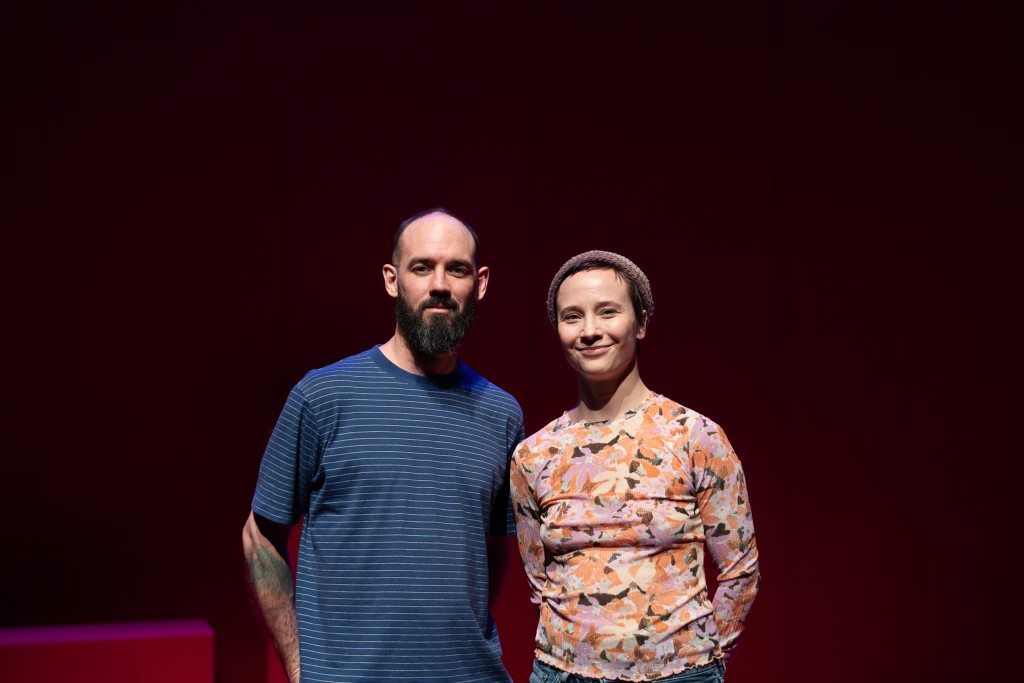
People spend a significant part of their lives sleeping, dreaming, or otherwise guided by the subconscious. Annamari Keskinen and Ryan Mason’s work DREAMER draws from these states of sleep and subconscious, where the mind moves freely without the constraints of conscious thinking.
“We are not interested in linear storytelling, but in how dreams have their own logic. Dreams are playful and open, anything can happen in them,” Keskinen says.
Keskinen and Mason have been working together since 2017. They got to know each other when they were dancers in the same group in Germany and then started choreographing together.
Valtteri Raekallio , the director of Helsinki Dance Company, says that he has been following their artistic work for almost a decade.
“I feel that they are purposefully developing their own aesthetics and open-mindedly looking for new choreographic forms of expression. I believe that they offer our dancers an interesting challenge with their associative and imaginative work.”
A long process
Keskinen and Mason say that they work in a process-oriented manner. One of the first decisions in the design of DREAMER was a fuchsia-coloured stage, which is meant to feel like a metaphysical or existential waiting room.
“The monochrome space is very clean, which makes it open to the imagination. Add music, lighting, or scenes, and the space changes with them,” says Mason.
Before the direction of the work began to take shape, the choreographers focused on getting to know the dancers.
“It’s a long process where we try things out and go on a kind of psychophysical journey with the dancers. The time we spend with them before building the actual work is essential to the end result,” Mason says.
They often utilize tasks as part of the creation process. “We give the dancers an idea that they are working on. After that, we select elements from what we see and start developing them towards something more defined,” Keskinen describes.
“We work in close dialogue with the performers and take into account their personality and natural movement language. On the other hand, we’re careful about how we fine-tune the movements and put them on stage,” Mason says.
The movements are not based on traditional dance styles or classical techniques, but are born from the dancers’ inner world, which they bring out without predetermined step patterns. The aim is for the movement to express the inner landscape and to enter into a dialogue with the space and the stage.
Personal Meanings Behind
DREAMER pulsate questions about the experience of meaninglessness and how to find meaning in the midst of chaos. Is it possible to let go of the need to see things as permanent or unambiguous? How can you create your own meanings in a world where traditional structures and beliefs no longer support you?
“They may not be obvious in the work, but they have a subtle effect on it,” Keskinen says.
Keskinen and Mason say that they want to create a work that does not seek to provide answers, but rather to ask questions and examine things to which there are no answers.
They point out that experiencing a work is much more important than analyzing it.
“It’s much more interesting to find personal meaning than to focus on how well it deals with a particular subject or try to understand what the choreographers want to say with the piece,” Mason says.
“We have an intuitive need to put certain things on stage at the same time or next to each other, but our reasons may be different from how someone else experiences it,” Keskinen continues.
“The work consists of layered associations, but it does not strongly present any specific thing. We try to keep the space quite open and create something special,” Mason says.
Text Ida Henritius