Love in tones
Unlike many famous musicals, the Irish indie film Once didn’t need a million-dollar budget to hit the spot with its message about the ambivalence of love and the importance of music in communicating the strongest of emotions.
Running through the centre of Dublin is the half-kilometre-long picturesque promenade Grafton Street, one of two well-known tourist and shopping streets in The Fair City. At one end of the slightly curvy street, in January 2006, a cameraman with a massive lens could be seen filming something. People who walked by reacted to the giant lens tube and turned around, but could not distinguish with the naked eye who or what the lens was really pointing towards. And if they had asked, they would hardly have received an honest answer, because here was a secret film recording going on for an unknown “indie reel” named Once.
Behind the camera in the January cold, filmmaker Tim Fleming and director John Carney stood wrapped in thick scarves and pretended to be nothing, and those the lens zoomed into the distance were two red-haired street musicians named Guy (Glen Hansard) and his girlfriend Girl (Markéta Irglová).
“We had to film in secret, because we didn’t have the money to pay for the permits,” Carney later recounted. The entire film’s budget was 112,000 euros, most of which came from the Irish film institute Bórd Scannán na hÉireann, the rest from Carney’s savings and loans. The entire shoot with the smallest possible crew took only 17 days, but despite the modest conditions, they managed to capture some of that magic that really great movies have, and the success was as obvious as it was surprising to the team itself – a year after the premiere, Once had recorded a whopping twenty million euros and won a tenth Oscar for Ireland for Glen Hansard’s suggestive theme song “Falling Slowly”.
“While we were waiting for the award ceremony, I received a text message from Bono,” Hansard said afterward. “It gave me the feeling that now we are doing this for Ireland.” It was John Travolta who read out the nominations: And the winner is … “When I heard him say Gle-, I got a two-hour blackout.” Hansard was visibly shocked up at the podium: “Thanks! Thanks for taking us seriously! Make art! Make art!” while Irglová elegantly managed to encapsulate the entire ethos of the production in her elegant formulation: “Fair play to those who dare to dream.”
Following the success of the film, Irish playwright Enda Walsh took the script to work, writing the stage adaptation of Once , which premiered in April 2011 at the American Repertory Theatre in Cambridge, MA, before it was staged at the Off Broadway New York Theatre Workshop in Bowery in December of that year. Soon, the play was “upgraded” to Broadway and won eight Tony and four Drama Desk awards in 2012. This was followed by Dublin, London’s West End and the first non-English language version in Seoul, South Korea.
In October 2020, the musical Once will have its Swedish-language premiere at Lilla Teatern in Helsinki, which will also have its Nordic premiere. The script has been translated by Annina Enckell and the lyrics by Tobias Zilliacus. Both have extensive experience in translations and adaptations, and are happy to offer the secrets of a successful transfer from one language to another.
“When you translate plays, you have to understand what happens between the lines,” says Enckell. “And at the same time, you have to be sensitive to the local – what works in Dublin doesn’t always work in Helsinki. For example, the Irish are more talkative than we are.”
“Translating songs from English to Swedish reveals the lyrics,” says Zilliacus. “We’re so used to hearing pop music in English that the voice becomes like an instrument, but as soon as you translate, you start to wonder what they’re actually singing. If there were more serious Finland-Swedish music, it wouldn’t sound so unusual. Now you always react when someone sings in Finland-Swedish.”
Zilliacus doesn’t play any instruments or read sheet music, so he approaches the songs by listening to and “taking in” the song, capturing the essence, the emotion and the message.
“You can’t translate word for word, you have to create a parallel work that works as its own song.”
A big part of the magic in the songs is the ambivalence in the receiver, you never really know who they are aimed at – is Guy singing about his love for his absent girlfriend, or is it Girl he is thinking about? The magnetism that alternates between the main roles keeps the tension up and melts all hearts.
“It’s the magical element that made Once a success,” says Enckell. “The bittersweet love that must not blossom.”
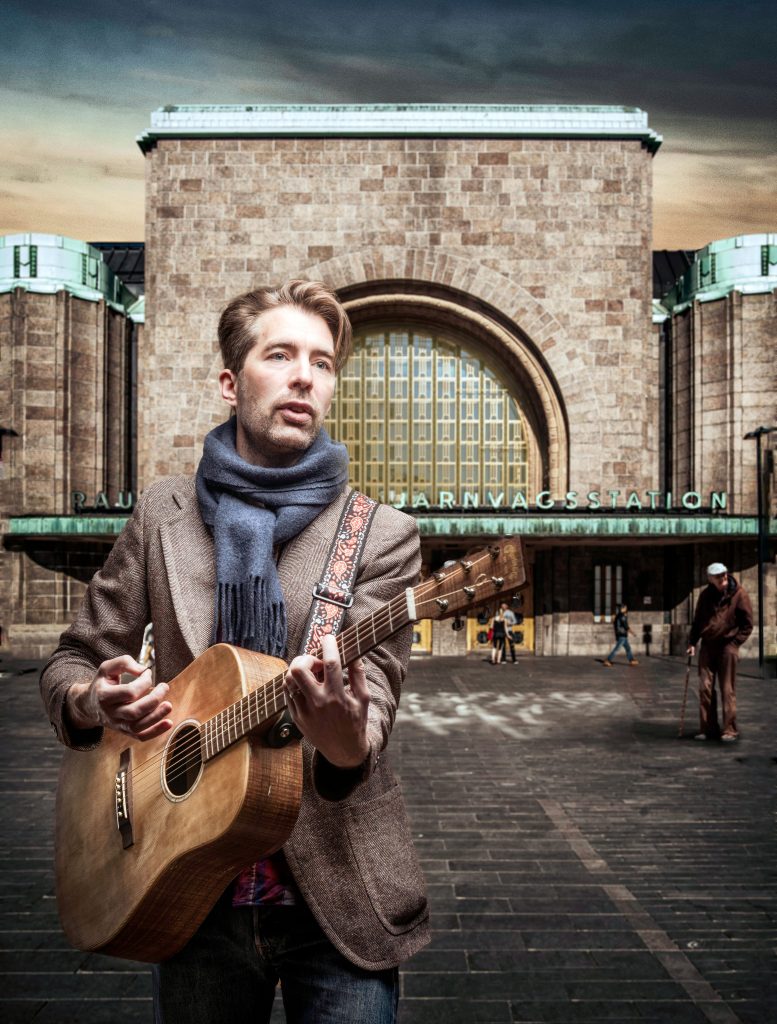
On Lillan’s stage, it is Tuukka Leppänen and Emma Klingenberg who are given the task of carrying the tension. For Leppänen, the role of Guy is a long-term dream come true.
“I’ve always wanted to play Once,” Leppänen says. “So when I got the chance to do it in Swedish, it was obvious that I would take the chance, even though I usually play in Finnish.”
It was also an opportunity for Leppänen to finally learn the language properly. Like many other Finnish speakers, the basics of Swedish are there somewhere in the brain clefts, but are rarely used.
“I immediately booked private Swedish lessons, and I have also received a lot of help from Lillan’s soufflé Ragni Grönblom,” says Tuukka, who has approached the task with almost scientific precision and ambition.
Leppänen says that his acting technique is based on “planting” the lines in the body, so that he can then concentrate on the stage presence with the co-stars, the music-making and the movements. “It should fit so well that the audience doesn’t have to think that it’s my third or fourth language.”
Text: Janne Strang