Movement and emptiness and slight movement of internal organs
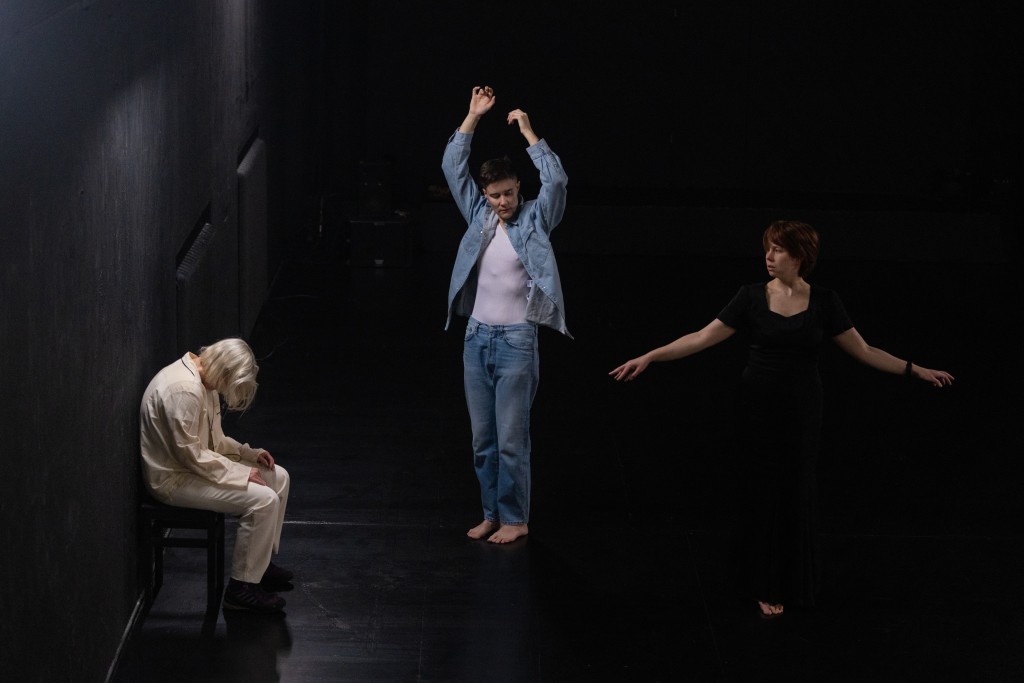
How does Movement and Emptiness feel as a performance? What kind of sensations does it suggest? What is its performative tone of voice and the essence of the movement?
Be exposed and let yourself be pierced by the presence of Ami Karvonen, Kid Kokko and Anna Mustonen’s performing bodies! Give yourself space to settle down, give yourself permission to sink and stop performing. You can rest for a while. Fear not. You may not be able to avoid restlessness or slight anxiety, but now you are allowed to just be and breathe – maybe even grieve.
Movement and emptiness give way to expectations of what the performance should contain. It is passively resistant. It has emptied and cleaned almost everything about itself – just as one performer in the prologue of the work empties the contents of his pockets on the floor of the entrance hall of the Pasila stage.
The emptiness begins even before the deed. As an audience, we expect outside the theatre. The performers arrive along Ratamestarinkatu towards the theatre and open the doors to the theatre’s empty lobby.
In complete silence, the performers fall into place, one to lie down on the carpet, another to the coat racks and the third to the vicinity of the person lying on the carpet. The performer gets the sounds of the waves from his mobile phone. Time passes. As in a ritual, the person lying on the ground with gentle care is first taken off his shoes, then his mittens. The lying body rises. Another exits down the stairs and the third empties his pockets. We will follow.
Give up and let go
We are facing emptiness and extremely frugal movements. The black stage is also empty, surrounded by only a few black stage curtains. On this stage, the performers settle down, usually centrifugally, seeking out the edges of the stage.
I immerse myself in the movement of the performers and the sadly lazy events. Movement and emptiness is a series of sinking, slumping, staying in one place, lying on the ground, breathing, dragging, turning to the other and wrapping oneself, separation, freezing in an unfinished movement or in one place, seeking the edges of the stage, exiting. The presence of emptiness weighs on and attracts.
The performer rests on the other’s lap, breathes, the other’s hand moves gently through the hair, neck, body. The words create an image of a water-permeable stone, three stones as if they were three living bodies. Few words are attached to an attempt to give up, to relax. The words are also attached to the sea and the desert. “By the ocean, you don’t think about form”, “Space seems to open up”, “The same thing as far as the eye can see”. The desert is timeless and placeless. So is the sea. All of them provide liberating resistance as a certainty of existence. Earth exists, space exists, emptiness and silence exist.
The greatest movement intensities of the work are limited to the joint dance moves of the two performing bodies and the almost furious tearing down of the black stage curtains. We are also in complete darkness for a moment, sensing the increasingly intense flashing lights, which, as afterimages, illuminate the figure standing on the stage bridge. Flashes, glimpses. The complete silence of the work is not broken by the buzz of the lamps, nothing. Only the sounds of the sea, the breath and the flash-like words. At the end, the silence and emptiness are punctuated by music. The performer stands on the stage, fingers squeeze, extend, head turns upwards and sideways, time between each movement, time. Sometimes the body seems to breathe, and then the same thing happens again.
Rethinking the laws of making art
From the collapsed postures, you can sense exhaustion, sadness, I want to disappear and decay. The work was inspired by visual artist Agnes Martin (1912–2004), photographer Laura Aguilar (1958–2018), a prominent figure in chicano culture and queer art communities, and poet Sirkka Turkka (1939–2021). In their works, they have all dealt with depression and sadness, escape. Martin disappeared at the end of the 1960s into the experience of silence and disintegration. He lived forty days in his bedroom studio in the wilderness. Martin painted grids over and over again. His paintings are an exercise in meditative awareness and perception. Movement and Emptiness is one of them.Movement and emptiness are attached to the American tradition of minimalism as they remove elements of the work. But in the neoliberal reality of the 2020s, the minimalism of Movement and Emptiness is now born out of the desire to rest, to nurture oneself and others. An artist has the right to stop, to connect with themselves, others and those around them. The movement and emptiness end – with a slight movement in the internal organs.
Movement and Emptiness renegotiate the laws of making art and the invisible compulsions to perform. It is not alone in this kind of conscientious protection, support and care of a person. This week, Teatteri Takomo premiered Hanna Ahti, Anna Maria Häkkinen, Maija Mustonen and Niina Hosiasluoma’s Doom & Bloom. The bodies in it play, intertwining with each other, giving and receiving care. It has the silent power and sensuality of bodies in moments of blossoming and withering.
Text: Hanna Helavuori