“My Day as a Groundhog is a challenging work”
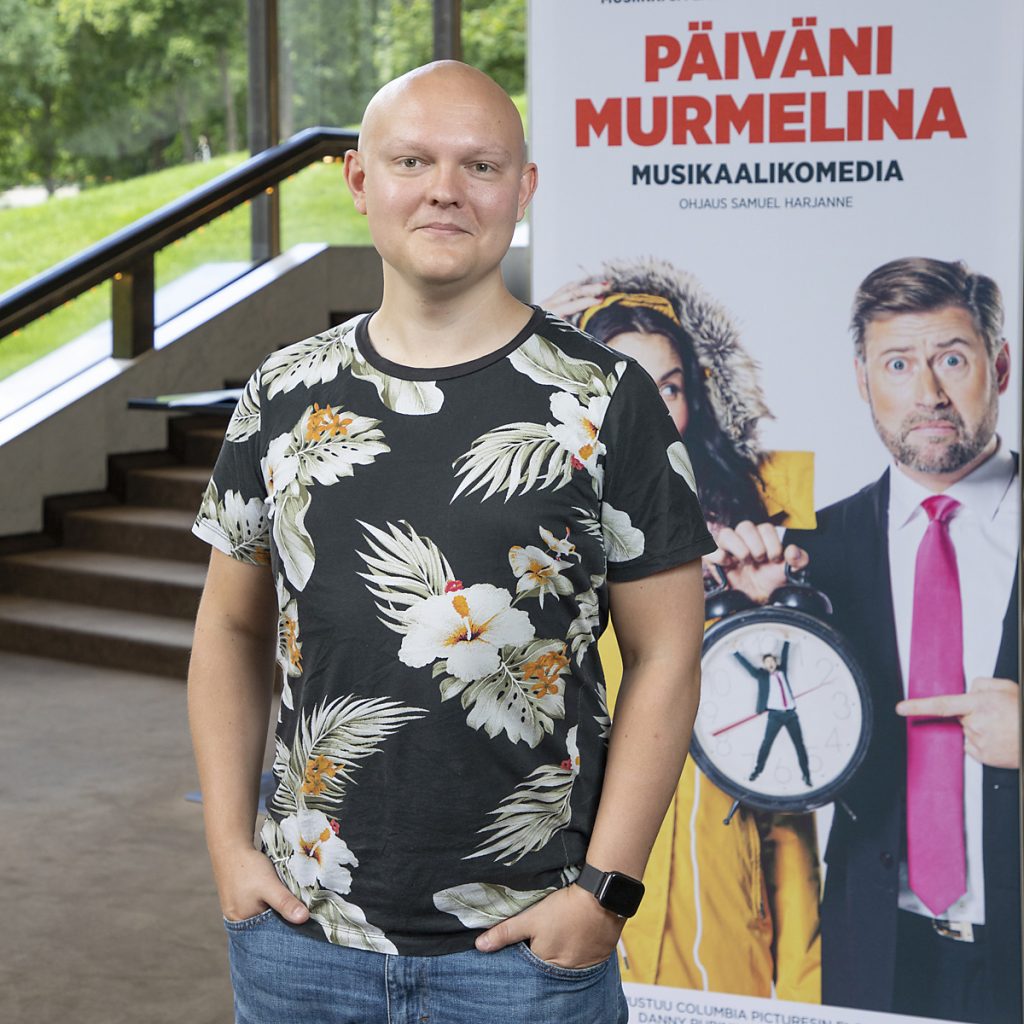
Samuel Harjanne is a musical director whose magnificent performances have been enjoyed on Finland’s largest theatre stages. This autumn, the big stage will feature both the hugely successful The Little Mermaid and the musical My Day as a Groundhog .
Samuel Harjanne is visibly enthusiastic about the musical My Day as a Groundhog.
“My Day as a Groundhog is a terribly good thing, and its text is really intelligent – how the musical lives the same day over and over again. It immediately raises the question of how on earth this is done on stage. What could be interesting about doing the same scene over and over again?” the director ponders.
According to Harjanne, the most challenging thing is precisely that reproduction; Every thing that happens on stage has to be identical the next time you see it.
“It requires absurd discipline from both those on stage and the technology behind the scenes.”
And we viewers don’t see the same day as long all the time, but we may jump quickly on stage, for example, from the afternoon to the evening.
“We need to have machinery that can run the whole day normally, but at the same time we need to be able to jump forward. It’s technically really challenging.”
Ingenious music
The music for the musical My Day as a Groundhog was composed by Tim Minchin, who, according to Harjanne, is quite a multi-talent: a stand-up comedian, musician and actor.
“Music is such a big factor in a musical that if it doesn’t awaken something in me, I wouldn’t be able to make the musical as good as it could be. As with the text, I have to feel something towards it and like it.”
Harjanne describes Minchin’s music as mathematical and ingenious.
“For example, there is one theme in the musical, which is composed so that each chord is always half a step from the next chord. And it is often repeated in different songs. This means that all twelve keys of the piano are reviewed in order and then it starts again. So the music has its own repetition, which is so intelligently written that it is respectable. I think 99 percent of the viewers won’t even notice it,” Harjanne laughs.
The most comprehensive art form
There are many elements in a musical that must be taken into account. Normal spoken word drama is made by the actors, set design, costumes, text, light and sound, but in the musical, musical and choreographic dramaturgy is also involved – the way the actors express themselves. The sets also need to match the timing with the music, and there are many other things that need to be carefully planned.
The most interesting thing about the musical for Harjanne is how the songs provide an opportunity to get to know the inner lives of the characters more deeply than the spoken drama.
“The song gives the viewer three minutes to get to know how the character feels. We, the viewers, experience music in such a unique way that what may go straight to your heart, can get cold shivers for me. When it comes to music, we can’t even compare our own experience with that of another person.”
“It is the result of a great composition and writing. A musical theme is formed for the emotion or role, which brings security and a sense of familiarity. It’s ingenious,” Harjanne says.
The level must remain high
Harjanne visits the performances at regular intervals to supervise the performances and gives feedback to the performers based on that.
“I want to keep the quality high throughout the performance season. My assistants send me reports and even pictures of the sound and light desk so that I can keep up with quality control. The performances evolve over the course of the season, the actors discover new things, and of course, the rhythms improve.”
Musicals are expensive productions for theatres because there are so many people involved in them.
“And luckily, a large number of people want to watch them – because it’s the best art form in the world,” Harjanne says.
Seamless collaboration
The challenges of the musical are solved in advance with the help of a scale model of the set.
Director Samuel Harjanne and set designer Peter Ahlqvist have both seen great musicals around the world and experienced such great experiences that it is always a goal they strive for.
“We want the viewer of our production to be able to experience something similar,” Harjanne says.
“Peter and I have collegial trust in other things than directing and he sets the stage. I feel that sometimes I need his eye during the directing phase and he needs my eye during the staging phase.”
In their joint projects, Harjanne and Ahlqvist try to solve the musical’s issues in advance. The tool is a detailed scale model of the set, which is preceded by many discussions between the set designer, director, choreographer and costume designer.
“In the My Day as a Groundhog project, Samuel and I have bounced ideas around, and during the video calls, I have drawn various proposals to collect material, take photos and gather ideas,” Ahlqvist describes.
“Marmot is a challenging work in terms of all its transitions. Thanks to the authors, even though we go to the same places over and over again, the world is still changing all the time.
The angle changes or the plot of the story turns, so the same sets are not pushed onto the stage in the same way, but the world is constantly being shaped,” Ahlqvist describes.
Ahlqvist thinks that a scale model is a good way to physically see what the set will be like.
“It may look like a toy, and as a working method, it is playing. Everyone can participate, you can rotate the model and try out how it works in the theatre space.”
The scale model works well in communal discussion around the same table, and it is a valuable tool for the workshop in building sets.
For Harjanne, it is important that collegial artistic work is realised in decisions, that things are done together all the time. As a result, there is no longer a need to argue about why a door is where it is or why it opens in a certain direction.
Text Kari Martiala