The building blocks of a French farce – interview with translator Reita Lounatvuori
The Helsinki City Theatre has a long tradition as a stage for farce. But how does the farce translate into Finnish? Translator Reita Lounatvuori, who has translated several farces into Finnish, explains how to recognise a farce and what kind of difficulties must be overcome when translating verbal cannon from French into Finnish.
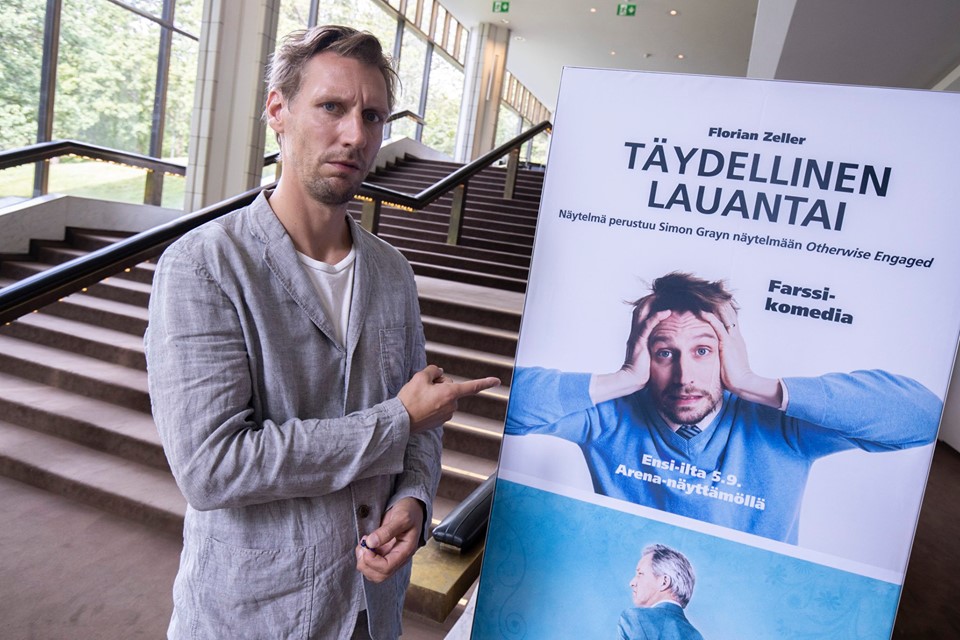
Reita Lounatvuori began her career as a translator of play texts in the late 1990s. To date, he has translated about 70 plays into Finnish in English and French. The genres have varied from contemporary drama through American classics to Molière.
The name Lounatvuori is familiar to fans of farces and comedy. In autumn 2019, the Helsinki City Theatre will present two French works translated by Lounatvuori, the farce Perfect Saturday and the comedy Threesome. He has also translated into Finnish, for example, the farces Hotel Paradiso and The Hired Killer’s Nightmare, which are familiar from HKT’s programme in the past.
How can the viewer recognize that they have come to see a farce?
“The most obvious characteristic of a farce is, of course, the doors and their importance,” Lounatvuori laughs. “People are banging on the doors that you didn’t expect to see at the time. The plot includes absurd misunderstandings and relationship messes. And especially in French farces, the characters talk a lot!”
Farce is a genre in which traditions are faithfully followed, even to the point of cliché. Lounatvuori mentions that Perfect Saturday, which premieres in September, begins to approach a parody of farce in its conscious cliché, as every classic character of farces rushes in through the doors, from a secret lover to a funny foreigner.
“Playwright Florian Zeller has used all possible farce regulars in Perfect Saturday. He said in an interview that he had written scenes on a holiday trip with which he tried to make his travel companions laugh in the evenings, and that he had compiled A Perfect Saturday based on them.”
Slang words and syllable counting
When a foreign play text is brought to a Finnish theatre, the translator’s role is to ensure that the playwright’s ideas are conveyed to the Finnish audience as clearly as possible. Translating humour into another language often requires creative solutions.
In Perfect Saturday, the names of the characters hint that minor changes have been made to the text. In France, the central characters of the farce are known as Michel and Nathalie, but at the Helsinki City Theatre, the audience can follow the adventures of Markus, Helena and co.
“Sometimes play texts are integrated according to the director’s wishes, as long as the copyright holders of the text give permission for it. Many comedies work better when moved to Finland or some obscure but familiar place, when you can include names, places and products that are familiar to Finnish viewers,” Lounatvuori clarifies.
According to Lounatvuori, the characters’ entire speech must be rethought in a way when translating the farce into Finnish. In comedy, word orders must be made to serve the highlights of the jokes so that the hook only comes at the end of the line. There is also plenty to think about in the choice of words.
“No one really speaks the written language here, even though you sometimes hear it in plays. In comedies, I want to imitate how people actually speak, so that there is nothing in the language that interferes with the passage of jokes.”
In addition to the language she uses in her own life, Lounatvuori seeks inspiration from online discussion forums, for example. When Finnish equivalents are needed for the terms used by the young characters, the translator resorts to the help of his friends’ children.
“I also have this kind of absurdity that I might count syllables from the original text and the translation. It is important to me that the Finnish translation does not go much further than the original text. In Finland, the words are longer than in French, but by bouncing around the ball, you can often find a way to express the matter as concisely as in the original text.”
Aiming only for laughter
Although details sometimes have to be adapted to domestic conditions, farces rarely encounter real culture shocks. According to Lounatvuori, the Finnish and French people’s senses of humour coincide well – except perhaps when it comes to food and drink, as the French who are passionate about their meals may sometimes miss the jokes on the subject by Finns who are used to simpler food.
Basically, the desire to enjoy carefully constructed humour is shared.
“Farces only aim for laughter. Once, a director I know called me and told me that he had been thinking about the possible angles of the text of the farce I had translated into Finnish. I told him, ‘Good person, there are no corners, you have to open those doors at the right time and make the audience laugh,'” Lounatvuori recalls.
The translator believes that Perfect Saturday will succeed in its task.
“We made the final version of the translation together with director Jaakko Saariluoma . He has directed the same play in Swedish at Lilla Teatern, so he was able to give practical perspectives to the Finnish translation: you see, this is what this character is doing… It’s rare to get to swish with someone just when you’re turning!”
Siiri Liitiä