The music is created in the rehearsals by means of process work
Punk, Tchaikovsky and workers’ music – all of these will be heard in Mikko Räsänen’s future.
“The music combines extremes and moves between upper-class music and raucous industrial,” says composer Timo Hietala .
The play takes place at the city’s sewer construction site, where the renovation of the water supply is underway. The city wants a temporary bicycle path to be built on top of the sewer trench for the online streaming campaign. Sewer worker Mikko Räsänen and service designer Lasse Kosonen, who is responsible for streaming, are at odds over the project.
Mikko Räsänen represents a traditional, concrete worker, and Lasse Kosonen represents a knowledge worker in the creative class. At the heart of the play is the encounter of these two worlds.
“Music is used to play with whether there is such a thing as middle-class music and worker’s music,” Hietala says.
A one-man band
All the music in the play is played by multi-instrumentalist Joakim “Jusu” Berghäll, who has played several different instruments since he was in secondary school. Patience was not enough to practice just one instrument.
“When I was young, many people tried to tell me that I should focus on just one thing, but I didn’t believe and continued with what felt right to me. In retrospect, what appeared as impatience has been an essential thing in growing into a musician,” Berghäll says.
Berghäll plays a grand piano, guitar, cello, baritone saxophone, percussion and various everyday objects that can be used as instruments at a height of four metres.
The trumpet is one of the only instruments that Berghäll does not know how to play. “We’ve been teasing Jusu that we need to get a trumpet here,” Hietala jokes.
Instead of a trumpet, Hietala ordered a solo from Berghäll with a bicycle pump. Berghäll has learned to play it like a flute. “Timo has a charming tendency to challenge and make the most of it,” Berghäll says.
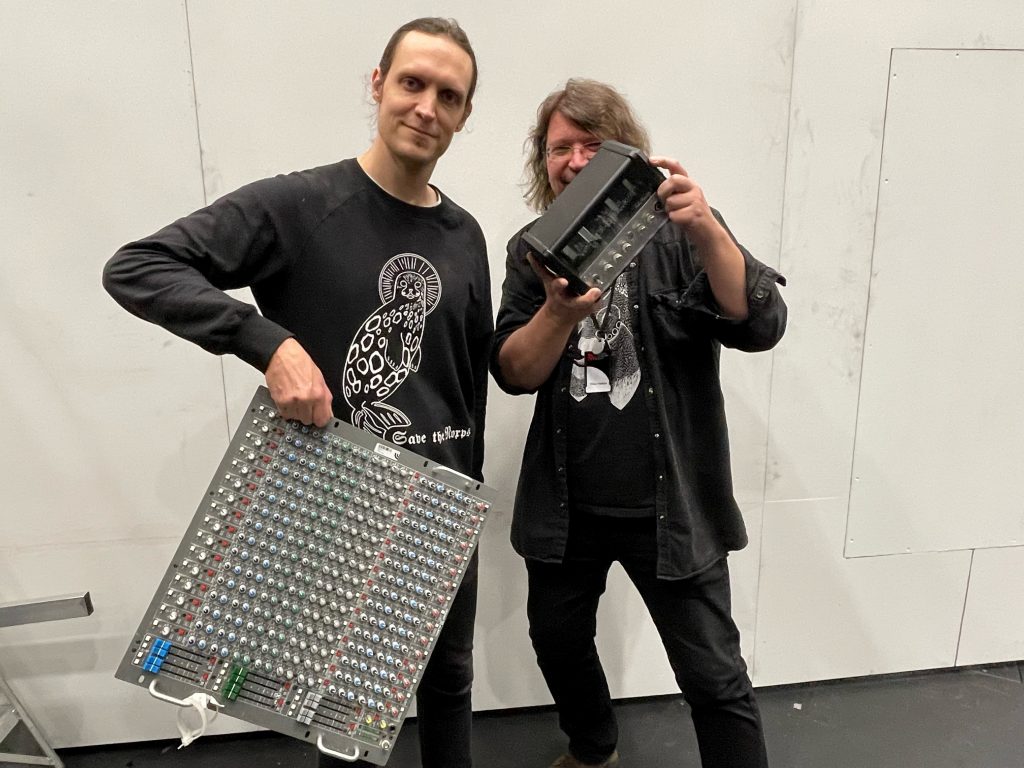
Electronics are also used in the music. The “band” is then made to sound bigger than it would otherwise be possible for a single player to sound. For example, Berghäll has a looper that can be used to record, for example, a hand drill, and then play over the recording.
In addition, the play features a lot of material that moves on the interface of music and sound work, which makes use of the sounds of a sewer construction site.
“For each scene, I wrote down all the possible sounds that could be heard there. Together with the sound designer [Eero Niemi], we have searched for and recorded these sounds of the construction site and the city,” Hietala says.
The composition process takes up the entire rehearsal season
Mikko Räsänen’s future is not a musical play, but music and sound are used a lot. “The director is good at music,” Hietala knows from experience. He has composed music for several films and plays directed by Heikki Kujanpää .
Before starting composition, Hietala brainstormed and planned the style of music with Kujanpää. They go through the script one scene at a time and think about what the focus of each scene is, what the scene is aimed at, and what can be done with music and sound in the scene.
Based on this, Hietala makes some advance plans and small pieces before the start of the rehearsals. However, the music is mainly composed only during rehearsals.
“In theatre work, you can do work in advance, but it is not at all certain that the song is suitable for the play. The instructor may have the wrong emotion or mode, and then you have to go to the studio with your tail between your legs and bring a new song to the next rehearsals,” Hietala laughs.
In rehearsals, Hietala and Berghäll begin to improvise in the scenes based on what the actors are doing on stage. Berghäll has all the instruments with him, Hietala has a keyboard and a laptop. “We listen to each other and look for the atmosphere of the scene together, and little by little it starts to form into tunes,” Berghäll says.
In Berghäll’s opinion, the most significant benefit of process work is that you can see what the actors are doing during rehearsals and hear the director’s and actors’ thoughts on the text and acting. Then the music becomes a natural part of the whole.
Hietala has ideas ready for some scenes. For example, he may ask Berghäll to turn on the drill and play the bad Tchaikovsky on the piano. The exercises are recorded to be able to check what works and what doesn’t.
The process of creating music takes the entire rehearsal season, as you have to perceive the entire arc of the play before you know for sure that the music fits into the whole. “Music as such has no value if it does not fully serve where the play is going,” Berghäll says.
“You have to be patient at work, because it takes a long time to get the end result. That’s why some musicians are not suitable for the theatre,” Hietala says.
Even though the music and sound work on the big stage must be carefully planned, improvised episodes are also left in the performance.
“I like that some things are left open for good. That way, the performance will stay alive, no matter how many times you perform it,” Berghäll says.
Ida Henritius