Theatre’s invisible events and agencies
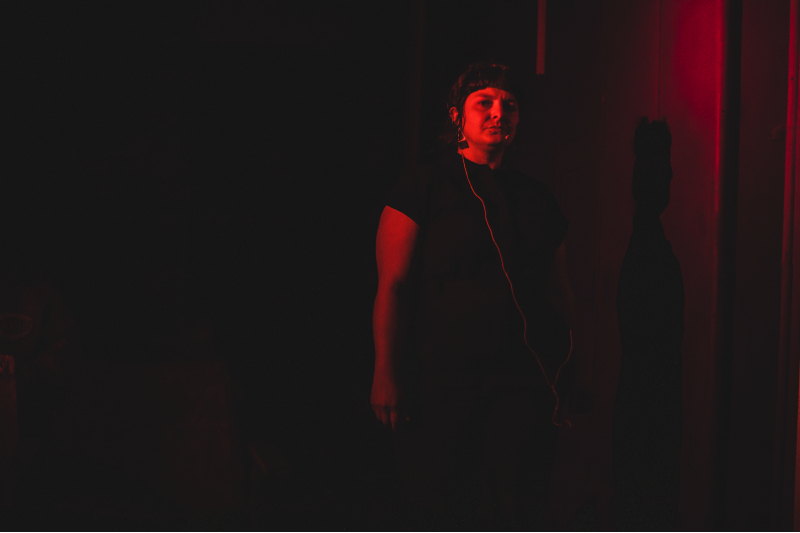
In the listening performance What is seen and what’s (left) behind the scene? Let’s take a peek into the memories, experiences and feelings of the employees of the Helsinki City Theatre about their own work. Representatives of the technical staff, those whose work is done offstage, get to speak.
The performance is created by Fjolla Hoxha from Kosovo, who works as a playwright, theatre critic and performance writer in Helsinki, Kosovo and Nashville, USA.
The performance at the Helsinki City Theatre is a continuation of Hoxha’s artistic project Modification as a Mode of Resistance, which she started while studying in the Theatre Academy’s Live Art and Performance programme.
Long-term project
The roots of the project go back to Hoxha’s experiences in the war in Kosovo, which took place in 1998–1999 when Hoxha was 15 years old. The war was based on a dispute between Serbs and Kosovo Albanians over which nation the territory of Kosovo belonged to. After the break-up of Yugoslavia in the 1990s, Kosovo – a province of the former Yugoslavia – sought autonomy and independence. Serbia responded to the Albanians’ independence goals with strong opposition.
The real cause of the conflict in Kosovo was the persecution of Albanians over the previous decade by the former Serbian President, Slobodan Milošević, which led to job losses, expulsion of people from educational institutions and the killing of civilians. As an Albanian from Kosovo, Hoxha was also persecuted, as he was not allowed to go to school because of his ethnicity, for example.
“I couldn’t process the war experiences for a long time. It wasn’t until I moved to Helsinki to study that I started reading the diary texts I had brought with me, which I hadn’t been able to read for twenty years,” Hoxha says.
Hoxha used the diary material in her master’s thesis, where one of the methods was to critically examine one’s own past from a new perspective. “I reconstructed diary entries by detaching and rearranging text fragments, and through that, I interpreted my past in a new way. I wanted to think that the person who wrote the text is not a victim but a survivor,” Hoxha says.
After graduating from the Theatre Academy, she wanted to expand the method from the individual to the experiences and memories of the community and the collective memory built from them.
Hoxha is interested in people whose voices are usually not heard. Those who usually do not step forward, but stay somewhere in the background.
“Because I have experience of belonging to a marginalized group, I am naturally interested in invisible people or those who are on the margins of society or communities,” Hoxha says.
In addition to theatre workers, Hoxha has applied the method to factory workers in Kosovo.
Making the scenes visible
For the performance at the Helsinki City Theatre, Hoxha and her team interview employees from different departments and stages, as well as those who have worked in the company for 30 years and three months. The aim is to interview those whose work is done hidden from the public’s eyes, and also to get acquainted with the City Theatre’s archives.
By combining interview and archive materials, Hoxha writes the script for the listening performance, which is read by the City Theatre’s attached actors. “I try to make sure that the voices of all the interviewees are heard in some way in the performance, whether it’s a single sentence or an entire story or memory,” Hoxha says.
Hoxha wants to highlight the work that is done behind the scenes and at the same time make the structures of theatre visible. The participatory sound walk also challenges the idea of sitting in the theatre, as watching a performance is not the only way to participate.
“I hope that the performance will make the viewer think about what is given space and visibility and what is not, and pay attention to what may not be visible at first glance.”
Ida Henritius
February 2023