What does love mean? A contemporary puppet theatre performance delves into the sociology of Romanticism
There are people who would never have fallen in love if they had never heard of love. – François de la Rochefoucauld (1613–1680)
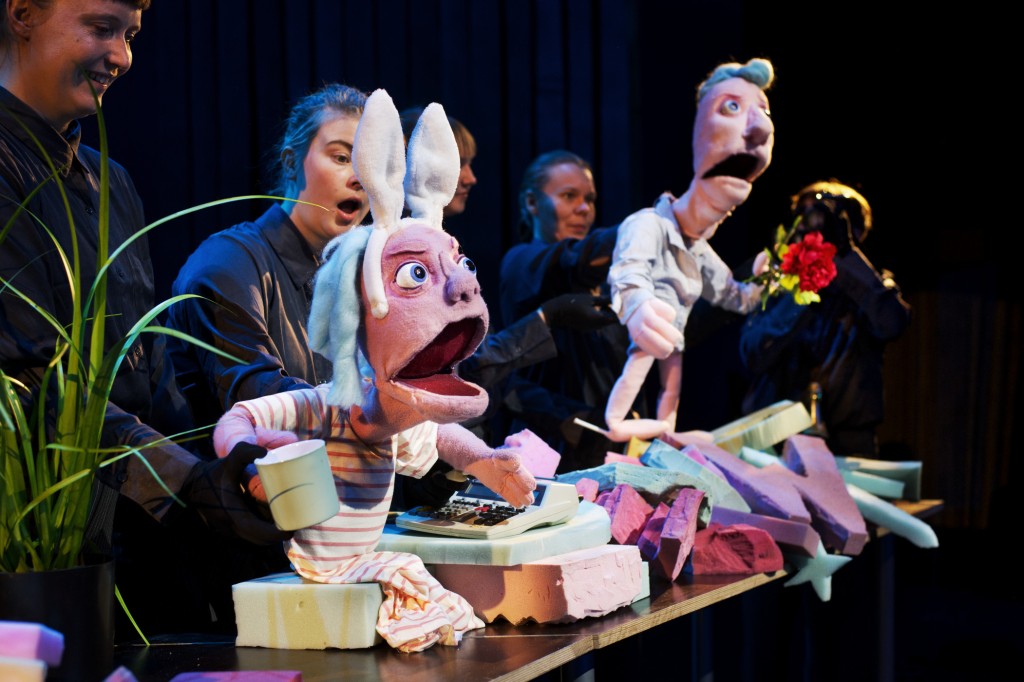
Working group Royal Cotton Candy’s contemporary puppet theatre performance Whatever Love Means takes place in a consulting firm where busy ambassadors of love try to guide their clients towards true love. One of the cupping characters is the Sociologist, who cultivates footnotes and interprets emotions with the help of scientific research data. The seemingly light-hearted performance tackles big questions as it examines the imagery of love and the ways in which romantic love is created and replicated in Western societies. As Professor of Sociology Ilpo Helén points out, relationships between people are compositions of historically changing practices. Tracing their origin and changes makes visible the possibilities of our own lives, experiences, actions and understanding. [1] Prince Charles was faced with fundamental sociological questions when he said “Whatever ‘in love’ means” alongside his fiancée Diana Spencer. [2]Reason and emotions
In the social sciences, emotions have begun to be examined as the use of interdisciplinary methodology and theoretical tools has increased in the 1990s. [3] Before that, emotions had been thought to belong to private life and thus to psychology, and in social research, emotions have often been examined with the tools offered by Freudian or Lacanian psychoanalysis. For example, philosopher Michel Foucault’s extensive work The History of Sexuality has had a profound impact on the social science line of thought, “according to which the essential features of the modern Western way of life stem from the fact that sexuality, the ‘drive’, is harnessed, shaped and limited by culture, morality and social orders.” [4] In this case, romantic love appears mainly as a sideline in the examination of sexuality and the organization and control of desire.
Systems that maintain order in society have included, for example, marriage and family relationships and gender control. Literary scholar Markku Soikkeli writes about how the development of the idea of love is linked to the process of social individualisation that requires the regulation of desires. The expression of emotions and their meanings are always culturally bound, i.e. they change in time and place. Love “as a commonly understood concept that can be distinguished from the everyday, economic and sexual needs of mating” has only become established in Western culture in the early 1900s. Even after that, romantic love has often been limited to the privilege of heterosexual couples and only slowly has it moved from the privilege of the upper class to a phenomenon that also structures the worldview of other social classes. [5] (The tragedy of Prince Charles and Diana Spencer is probably that in their case, the highest possible social status and the associated expectations and obligations made a so-called love marriage paradoxically impossible.)
The anthology Sociology of Emotions 1–2, edited by Docent of Sociology Sari Näre and published in 1999, brought emotions into the Finnish social debate. The work examines emotions as a social resource and as the basis for the formation of individuals’ social relationships and communities.[6] In the texts of the collection, attention is paid especially to the emotional relationships and power relations between actors who experience emotions. [7]
During the 20th century, when the different narratives, control and ties that bound communities changed and loosened, the life cycles built through the individual’s own choices began to be emphasized. At that time, pre-existing roles were no longer resorted to in the construction of one’s own identity, and emotions became increasingly important in the construction of an individual’s identity. [8]Thus, life choices are increasingly made in relation to what the individual’s desires and wishes are and what kind of people are able to strengthen this constructed self-image.
Sociologist Zygmunt Bauman analyses the thinking of his colleague Niklas Luhmann, according to which the search for one’s own identity is the primary reason for people’s insatiable need for love.
Who Says Will?
In his book Kärlek som passion (Liebe als Passion, 1986), Luhmann discusses the changes in the representation of love from the 17th century to the 19th century by applying systems theory. Systems theory examines the mystery of love as a code, or set of rules. [10] A single code is thus a rule or formula that guides the individual to interpret the representation of love, such as the authenticity of a declaration of love.
The code of love is a common communication tool for lovers, which is used to interpret the meanings of words and actions. On the other hand, the code of Western love is already so uniform and established that anyone can play the role of the passionately in love and use it for different purposes. Systems theorists emphasize that
“Since the 1800s, love has become more and more clearly a phenomenon related to the narcissistic self-project. Love guarantees the most personal experience and the determination of one’s identity through the other. Personal love sets such high expectations that those expectations are enough to ruin the achievements of the relationship. Intimate relationships are mainly used to strengthen one’s self-image.” [11]
It is no wonder, then, that the Kupidos consulting firm is flooded with clients who are increasingly difficult to help, if romantic love is just one piece in a ball sea consisting of the desires, hopes and possibilities of the building blocks of today’s people’s own selves.
The practices and expressions of love are built in relation to the community that surrounds them at any given time. In a physically confusing situation, we “resort to appropriate ways of expressing ourselves that encourage emotions”, i.e. a historically constructed code of love. Soikkeli states that “(K)ukki’s love affair is a social product even when it seems to rise above or against society.” [12] Conceptions and expectations of love also give a stamp or form to how one behaves when falling in love and what is understood in one’s own and one’s partner’s actions as expressions of love. [13] This is why Charles’ dry statement “Whatever ‘in love’ means” seems confusing, because it does not meet the expectations that are expected of the behavior of a person in love.
Love only
The reaction of the love code to social changes has been studied more extensively since Luhmann. [14] According to Soikkeli, what these approaches have in common is that they take an attitude towards love as a historically formed system that is distinct from everyday life, and which is maintained especially by philosophy and fiction. [15] In Whatever Love Means, the sign system of love is examined especially through films and TV series.
In the imagery of romantic comedies, the processes of falling in love follow recognizable paths that are therefore enjoyable for the viewer: the main couple transforms from enemies to lovers, is momentarily separated due to mishaps and misunderstandings, or realizes, for example, at the high school graduation ball that they are the right ones for each other. The films that are acted out shape the language of love and reproduce what we think showing love is or how it should feel (the lover hurries to follow the lover who is moving abroad to the airport! The lover plays a serenade on the cassette player under the beloved’s window! The lovers realize their love when they find themselves in two horse-drawn carriages! He is it!)
Love reality series show how ordinary people hope to fall in love, repeating the usual code of love and interpreting the signs of the other party, each more or less consciously acting out love. Soikkeli writes how, according to philosopher Julia Kristeva, a person in love “wants nothing more than to be able to use the generally recognized code of love” and to be able to build their own love story. In this case, falling in love is falling in love with a learned system in which the person in love recognizes their own and their beloved’s places and begins to reproduce it. [16] A good example of the cultural connection of love is, for example, the reality show Love Is Blind, in which (straight) couples are formed blindly. The American version[17] emphasizes the importance of wealth and social status in mating, while the Swedish version[18] emphasizes the sexual attraction between couples.
The temptation to form universal explanations of the world is also great in the interpretation of love. But as Professor of Sociology Pertti Alasuutari points out, it is not possible to explain social phenomena and individual behaviour with simple, universal laws. Social research can provide examples of the constructed nature of reality, not universal truths. Researchers must also identify and question their own roles, limitations and preconceptions that may affect their way of conducting research. [19] So what can happen when the Sociologist encounters love?
Whatever Love Means premieres on August 7, 2024.
Text: Riikka Thitz
References[1] Helén 1998, 500-501.
[2] ITN Exclusive: “Whatever ‘in love’ means” – Charles and Diana Engagement Interview in Full (1981). https://youtu.be/6lSmizRAe6A?si=QyTiM5UeS22COMYW[3] Näre 1999, 10.
[4] Helén 1998, 502.
[5] Soikkeli 1999, 19–20.
[6] As an example of today’s emotional discussion, see Einstein. for example, Helsingin Sanomat’s article Nokia’s collapse was the result of unprocessed emotions on the part of management, says a recent study (3.7.2024) https://www.hs.fi/visio/art-2000010507462.html[7] For more information on the politics of emotions, see Statistics Finland. for example, Ahmed 2018.
[8] Näre 1999, 11–12.
[9] Bauman 2000, 123–125.
[10] Systems thinking and love as the power and starting point of planetary thinking, see Statistics Finland. Kurenlahti & Jaaksi 2021.
[11] Soikkeli 1999, 31.
[12] Ibid. 21.
[13] Määttä 1999, 38.
[14] Soikkeli lists the studies of philosopher Irving Singer, sociologist Anthony Giddens and semiotician Julia Kristeva, among others.
[15] Soikkeli 1999, 21.
[16] Ibid. 33.
[17] Love Is Blind, 2020- https://www.netflix.com/title/80996601[18] Love Is Blind Sweden, 2024 https://www.netflix.com/title/81626839[19] Alasuutari 2007, 25–26, 236.
Sources
Ahmed, Sara 2018: The Cultural Policy of Emotions. Translated by Elina Halttunen-Riikonen. Tampere: so & so.
Alasuutari, Pertti 2007. Social Theory and Human Reality. Translated by a team of translators from the University of Tampere led by Kaisa Koskinen. Helsinki: Gaudeamus.
Bauman, Zygmunt 1997. Sociological Thinking. Translated by Jyrki Vainonen. Tampere: Vastapaino.
Helén, Ilpo, 2010: Life in Sexuality. Afterword in Michel Foucault: The History of Sexuality: Will to Know, Use of Pleasures, Concern for Self. Translated by Kaisa Sivenius. 2., new. institution. Helsinki: Gaudeamus Helsinki University Press.
ITN Exclusive: “Whatever ‘in love’ means” – Charles and Diana Engagement Interview in Full (1981). YouTube. Accessed 16.7.2024 https://youtu.be/6lSmizRAe6A?si=QyTiM5UeS22COMYW
Kurenlahti, Mikko & Jaaksi, Arto 2021. Love and Light: The Road to a Good Future. Jyväskylä: Docendo.
Love Is Blind, 2020- https://www.netflix.com/title/80996601Love Is Blind Sweden, 2024. https://www.netflix.com/title/81626839
Luhmann, Niklas 2003. Love as Passion: On the Codification of Intimacy. Translation: Ola Agevall; peer reviewer: Jan Inge Jönhill. Malmö: Liber.
Määttä, Kaarina: Rakastuprosessi ja kärlekkriisi 1999. In The Sociology of Emotions 1, Experiences and Intimacy. Edited by Sari Näre. Helsinki: Finnish Literature Society.
Nokia’s collapse was the result of unprocessed emotions on the part of management, according to a recent study. Helsingin Sanomat. Accessed 16.7.2024 https://www.hs.fi/visio/art-2000010507462.html
Näre, Sari 1999. The Sociology of Emotions in the Field of Social Research. In The Sociology of Emotions 1, Experiences and Intimacy. Edited by Sari Näre. Helsinki: Finnish Literature Society.
Soikkeli, Markku 1999: Kärlekkoodisto vakintuminen Euroopa 1600–1900-luvuilla. In The Sociology of Emotions 1, Experiences and Intimacy. Edited by Sari Näre. Helsinki: Finnish Literature Society.