What is seen and what’s (left) behind the scene?
The stage of a contemporary performanceNote: No longer in repertoire!
Showtimes:
Tue 23 May at 18.30 and 20.00, studio Pasila
Wed 24 May at 18.30 and 20.00, studio Pasila
Fri 26 May at 10, 11.30 and 13.00, studio Pasila
Sat 27.5. at 18, 19.30 and 21.00, studio PasilaLanguage: English
Duration: approx. 1hNote: During the performance, the audience will be transported in the space. There are a few stairs along the route. Please also note that there are some roadworks around Studio Pasila, which may slow down the arrival at the site by a few minutes.Performance times:
Tue May 23rd at 6.30 pm and 8 pm at studio Pasila
Wed May 24th at 6.30 pm and 8 pm at studio Pasila
Fri May 26th at 10 am 11.30 am and 1 pm at studio Pasila
Sat May 27th at 6 pm, 7.30 pm and 9 pm at studio PasilaDuration: approx. 1 hour
Language: English
Please note: During the performance the audience will move from space to space. There are a few stairs along the route. Please also note that there are some road works around the studio Pasila, which can slow down one’s arrival by a few minutes.
(Scroll down for English.)
What is seen and what’s (left) behind the scene?What is seen and what’s (left) behind the scene? is a participatory listening performance that consists of the stories, memories, experiences and feelings of Helsinki City Theatre employees in relation to their workspaces.What is seen and what’s (left) behind the scene? is a participatory listening performance that consists of the stories, memories, experiences and feelings of Helsinki City Theatre employees in relation to their workspaces. The performance by director Fjolla Hoxha and the working group invites you on an expedition to the City Theatre, where the guides are those whose work usually takes place invisibly. The performance aims to highlight the intersection where breaking the illusion of theatre leads to the revelation of its own structures.
Fjolla Hoxha is a writer, theatre critic and performance writer who works in Helsinki, his home country of Kosovo and Nashville, Tennessee. Her practice is based on diligent research with materials such as critical theory, oral history and narratives, as well as institutional and personal archives. Fjolla writes fiction and non-fiction, plays, scripts and reviews, and works as a multidisciplinary performance artist. Her works are mainly site-specific, participatory works based on individual and collective memory.
What is seen and what’s (left) behind the scene? is part of Fjolla’s long-term artistic project Modification as a Mode of Resistance, in which he uses the personal memories of factory and theatre workers around the world and the collective memory formed from them. In this way, the performances become tangible archives and ways to connect with the unknown (the past).
Concept, direction, dramaturgy: Fjolla Hoxha
Sound design: Timo Viialainen
Creative producer: Nelly Hakkarainen
Voice actors: June Hyde, Martti Manninen, Vappu Nalbantoglu
Production: Helsinki City Theatre’s Contemporary Performance Stage
Photo: Dylan Simon
The image is a twig-printed collage with the following photographs:
Opening of the Intimate Theatre in 1981, Helsinki City Theatre Archives
Juhani Rytkölä, Helsinki City Theatre Archives
Studio Pasila, photographer Miika Storm
The Stage of Contemporary Performance pilot project, which will be seen at Studio Pasila in 2022 and 2023, will bring various forms of contemporary performance into the Helsinki City Theatre’s repertoire. In 2023, the stage of the current performance will be divided into three premieres and two guest performances. The pilot project is supported by Kone Foundation.
///////
What is seen and what’s (left) behind the scene?What is seen and what’s (left) behind the scene? is a participatory sound performance that evolves from the stories, memoirs, experiences and the sensations of Helsinki City Theatre’s technical staff, in relation to their work spaces.What is seen and what’s (left) behind the scene? is a participatory sound performance that evolves from the stories, memoirs, experiences and the sensations of Helsinki City Theatre’s technical staff, in relation to their work spaces. The performance by director Fjolla Hoxha (and working group) is an invitation to explore City Theatre through the voices of those whose labour remains invisible. It’s an effort to bring to the fore the juncture where the illusion of theatre is broken by unveiling the structures that form its institution.
Fjolla Hoxha is a writer, theatre and drama critic and performance maker, working between Helsinki, her home country Kosovo and Nashville, Tennessee. Her practice is heartily based on assiduous research that mainly grounds on critical theory, oral histories and narratives, institutional and personal archives. She writes fiction and non-fiction, plays, scripts and reviews as well as works as cross-media performance artist, focused on site-specific participatory work that is informed by individual and collective memory.
What is seen and what’s (left) behind the scene? is part of Fjolla’s enduring artistic project Modification as a Mode of Resistance. Departing from subjective recollections towards the collective memory of factory and theatre workers in different geographies, her performances become tactile forms of archiving and connecting with the unknown (past).
Concept, director, dramaturg: Fjolla Hoxha
Sound designer: Timo Viialainen
Creative producer: Nelly Hakkarainen
Sound actors: June Hyde, Martti Manninen, Vappu Nalbantoglu
Production: Helsinki City Theatre’s Stage for Contemporary Performance
Image: Dylan Simon
The image is a risograph printed collage based on the following photographs:
Opening of Inintimteatteri in 1981, Helsinki City Theatre archive
Juhani Rytkölä, Helsinki City Theatre archive
Studio Pasila, photographer Miika Storm
Stage for Contemporary Performance is a pilot project implemented in studio Pasila during 2022 and 2023. The objective of the project is to include different forms of contemporary performance in the Helsinki City Theatre’s seasonal programme. In 2023, the activities of the Stage for Contemporary Performance are divided into three premieres and two guest performances. The pilot project is supported by the Kone Foundation.
View the programme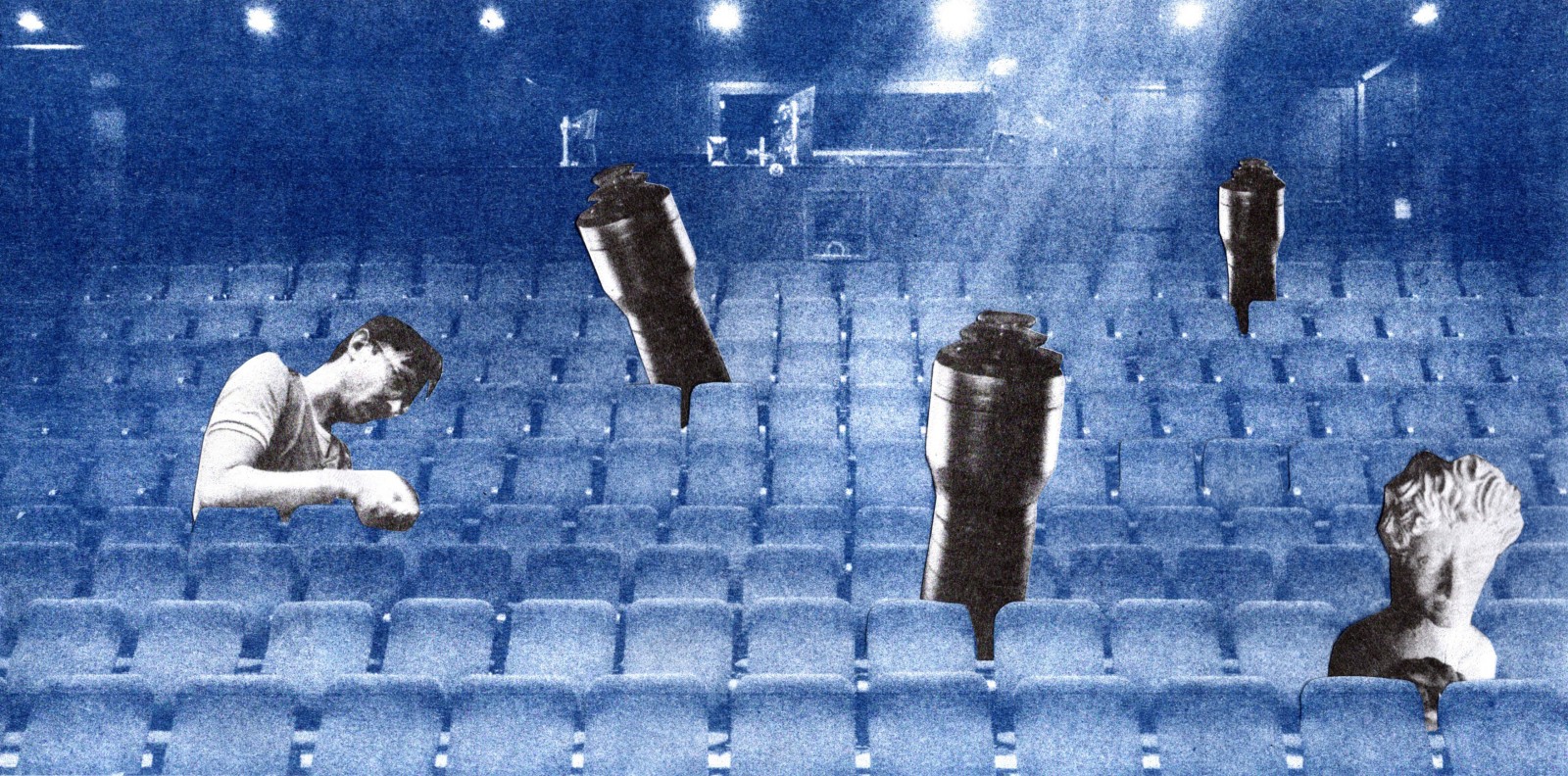
No comments yet