The theatre’s lighting and sound department employs lighting and sound designers, lighting supervisors, sound supervisors, lighting technicians, assistant supervisors and the head of lighting and sound – around 20 people in total. The Main Stage alone has approximately 200 spotlights, half of them motorised, as well as 600 dimmer channels and 900 relay channels, controlled using GrandMA 2 lighting consoles and the Paradigm lighting control system. The Main Stage has more than 100 loudspeakers. Mixing is carried out using Digico SD T-series consoles.
Lighting and sound can transform the atmosphere of a theatre performance in the blink of an eye. But what are they like as creative tools? What can lighting and sound communicate? And how do you become a lighting or sound designer?
Lighting can transform the atmosphere on stage in an instant
In his early twenties, William Iles watched lighting designers at work at Stoa Cultural Centre. It was the early 2000s, and Iles was completing his non-military service in Stoa’s stage technology department.
“Many contemporary dance productions visited Stoa, and they always had incredible lighting. It made a real impression on me.”
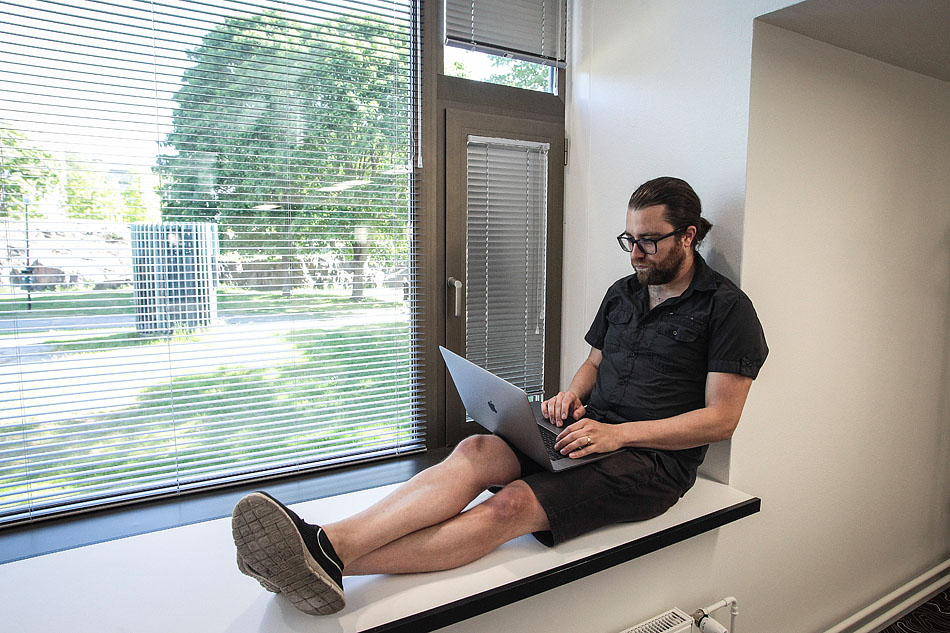
Having also been involved in theatre when he was younger, Iles was fascinated by how quickly lighting could completely transform the atmosphere or the entire stage picture.
“I also felt that I grasped the basics of working with lights fairly quickly. The building blocks are really quite simple: you have different kinds of lights, position them around the stage and use different colours. Then you use the lighting console to decide which lights are on at each point. It was easy to understand and fascinating.”
I was quite sceptical about how independently and freely you could pursue the artistic side of the work in a large repertory theatre like this. My fears turned out to be unfounded.
After completing his non-military service, Iles applied to study lighting design at the Theatre Academy and was accepted. During the final years of his studies, he was already working as a freelance lighting designer around Finland: in Turku, Tampere, Kuopio and smaller theatres in Helsinki. Then he spotted a vacancy in Helsingin Sanomat for a lighting supervisor with design responsibilities at Helsinki City Theatre.
“I was quite sceptical about how independently and freely you could pursue the artistic side of the work in a large repertory theatre like this. My fears turned out to be unfounded.”
After a year, his title changed to lighting designer, a position Iles has now held for eight years.
Lighting can shape a performance in many ways
Contemporary dance has remained particularly close to Iles’s heart as an art form.
“It made such a strong impression because it was so incomprehensible and strange. I still don’t understand it at all, but I’ve learned to accept that it simply leaves me with an impression of something.”
In dance works, the set is often more minimal or suggestive, giving the lighting more space and a heightened significance.
“Lighting can emphasise very different things, and it serves many functions. First of all, audiences usually want to see the performers. That is the functional role of lighting in theatre. Lighting can also communicate concrete things, such as the time of day and the weather.”
“But lighting can also convey more abstract ideas – even psychological ones. What is the world we want to inhabit? What else do we want to see, or not see? Why is one character suddenly illuminated so brightly on stage? Lighting can also communicate things on a subconscious level,” Iles explains.
“With a new work, it is always important to be drawn into its world and understand what it is about. We have extensive discussions with the production team and the other artistic designers about what we are aiming for and what kind of performance we want to create together.”
Live gigs bring variety
Iles has worked as a guest designer at the Finnish National Opera and has also “flashed a few lights around”, as he puts it, at his friends’ bands’ gigs at Tavastia.
“It’s been great fun. Everything happens entirely in the moment. But I wouldn’t light for the camera. That’s a completely different world. I don’t know cameras. In this job, I create things for my own eyes.”
When you work at the country’s largest theatre with the best resources in Finland, it is difficult to imagine a better place to be. However, Iles might be interested in working abroad at some point.
“It’s certainly an exciting thought. But right now, I don’t feel any great urge to go anywhere,” he says.
Sound is also a visual element
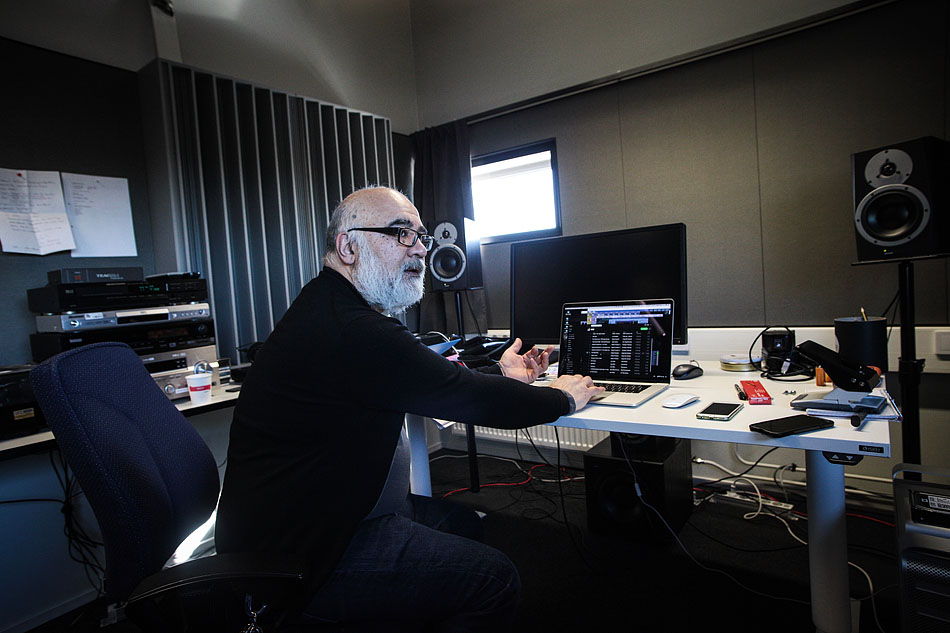
Eradj Nazimov remembers his first production at Helsinki City Theatre well, even though it was a couple of decades ago.
“It was a dance performance by Jorma Uotinen. It used pre-recorded music, and we had to read the choreography to know when the music should start, stop or change. Everything was done manually. I’m very grateful for that production, because it taught me how to read choreography on stage.”
“Uotinen had a wonderful way of combining the visual world with music,” he says.
Nazimov has travelled a fascinating path from the mountains of Tajikistan to become a sound designer at Helsinki City Theatre. Music, however, has accompanied him throughout his life.
“My father was a famous singer. I’ve always felt a need to play music. There is so much great music in the world.”
Riki Sorsa’s ‘Reggae OK’ was huge. Everyone danced!
His hobby became a profession. While studying at film school in Moscow, Nazimov worked as a DJ.
“It was an interesting time. I also knew some Finnish songs well, because people listened to them in Russia in the 1980s.”
“Riki Sorsa’s ‘Reggae OK’ was huge. Everyone danced!” he laughs.
Russian television at the time also encouraged him to combine visual worlds with music.
“Television programmes were so stupid back then! It was mostly news, and the presentation was very impersonal. We would mute the television and play our own music instead. That was how we reinterpreted the programmes.”
A conduit for something greater?
After moving to Finland, Nazimov found it difficult to secure work in the film industry. He ended up working for a company providing sound reinforcement and concert services, which also worked with Helsinki City Theatre. When the company’s technical director moved to the City Theatre, he invited Nazimov to join him as a sound technician. The year was 1989.
“I said yes, and I haven’t regretted it for a moment!”
Nazimov started at the theatre as a “mic boy” and soon realised that he had plenty of ideas and a clear vision for creating the sound worlds of performances. Others noticed this too, and Nazimov eventually became a sound designer.
“Compared with 20 years ago, when sound design was more about adding thunder and doorbells to a performance, I am now involved throughout the entire process.”
“A new production begins with a discussion with the director. You have to enter the world of the performance. But sound-related ideas are difficult to communicate on paper or even through conversation. That’s why I begin by collecting all kinds of material connected to the world of the production: images from Pinterest, videos and music,” he explains.
Another important discussion takes place with the set designer. Sound comes from loudspeakers, and each one needs its own place in the set.
Compared with 20 years ago, when sound design was more about adding thunder and doorbells to a performance, I am now involved throughout the entire process.
“Sound is used in so many different ways in theatre. It’s completely different from a concert, for example. We have speech, music and special effects. They all need to be in the right balance. We have more than 100 loudspeakers.”
Whenever possible, Nazimov prefers all sound to be created on stage rather than played from a recording. He admires the way theatre is made and sound is used in countries of the former Eastern Bloc, for example.
“It’s simple and ingenious. I remember seeing a production of Hamlet where, during the duel scene, a row of men holding swords stood behind the fighters. When the fight began, they swung their swords around, creating the soundscape live on stage. I think that is much more powerful than playing the sound from a recording.”
Although scripts rarely say anything about the sound world, Nazimov says that he picks up the rhythm and atmosphere as he reads. The work becomes interesting when he begins discussing the production with the director. The text starts to “come alive”.
“I believe in premonitions. I also give things time to happen. I try not to rush ahead of them.”
“Sometimes I watch my own productions and see how things have been done, but I can’t explain at all why they were done that way. I think it comes from somewhere higher. I am merely a conduit. There is never any explanation for why things have been done in a certain way. In the end, I simply watch the performance and think, wow, so that’s how it turned out!” Nazimov says.
A one-hour musical mixing session condensed into one minute.