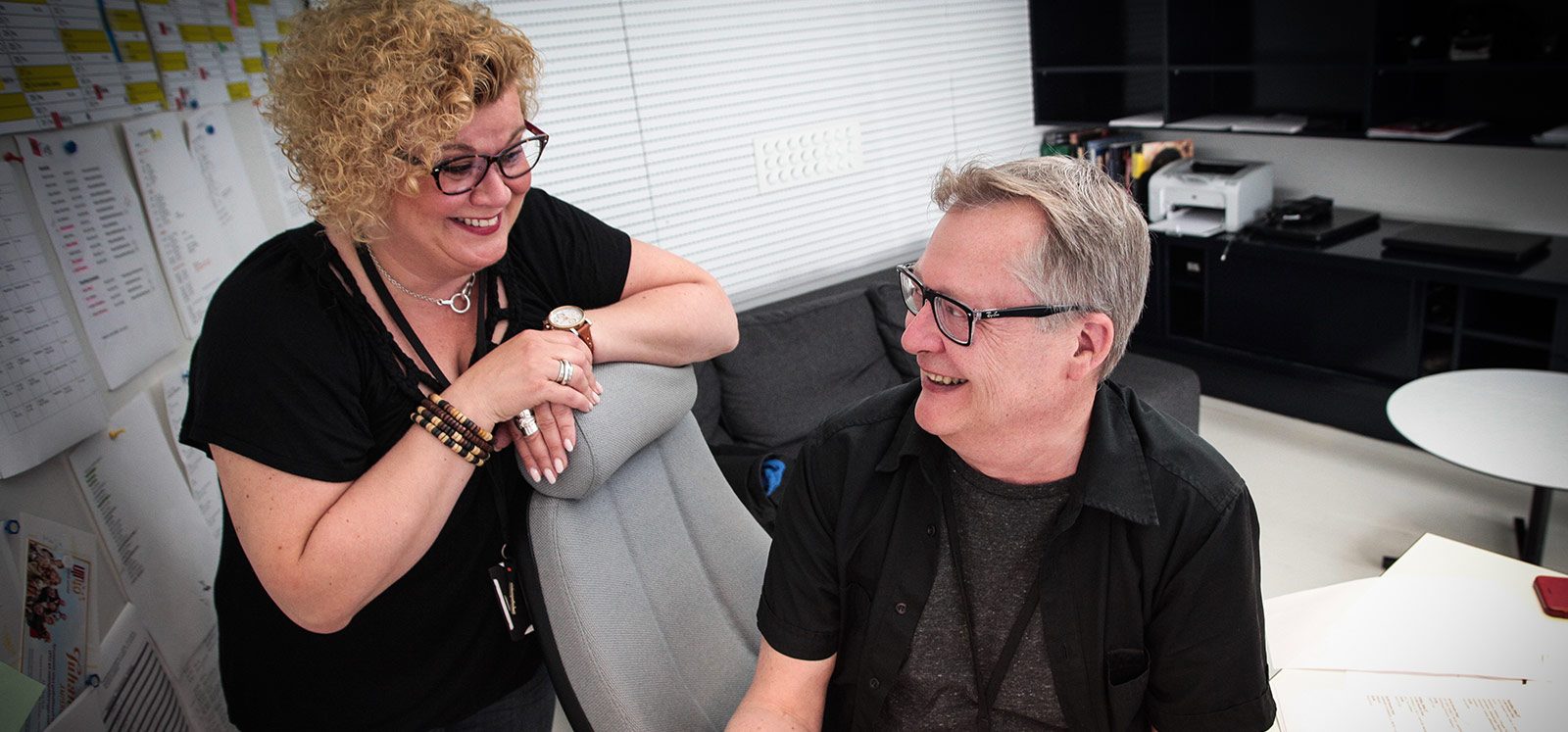
Helsinki City Theatre employs four producers and a production manager. Each production has a designated producer who draws up its budget and ensures that everything progresses according to plan, right through to the premiere. The production planner manages the overall schedules for all productions. They schedule performances for every stage and make long-term plans. The producer, production manager and production planner work closely together throughout the production process. The production department also includes assistant directors and the curator of the contemporary performance stage.
A thousand-performance puzzle
Five stages, around 20 premieres and more than 1,000 performances in total. Around 50 in-house performers, plus visiting freelancers. Hundreds upon hundreds of rehearsals and dozens of auditions. The task is to schedule it all so that everything runs smoothly, resources are allocated sensibly and everyone knows where they need to be and when. And, of course, to ensure that each production progresses as agreed.
Did I mention budgeting?
This staggering operation is managed by Helsinki City Theatre’s producers, production manager and production planner.
“Working with the schedules can sometimes feel like playing Tetris,” says production planner Jari Fluuri. “Finishing a season and sending all the performances on to ticket sales is always an occasion to break out the sparkling wine!”
“I’m sure most people never realise just how big this puzzle is,” producer Pia Karetie agrees. As a producer, she oversees the production’s progress right up to the premiere, draws up contracts with visiting performers and prepares the production budget.
Working with the schedules can sometimes feel like playing Tetris.
“The better you know the work in advance, the more accurately you can plan the budget. Thank goodness we have Finland’s best professionals in every department of the theatre! If you don’t know something yourself, someone else will.”
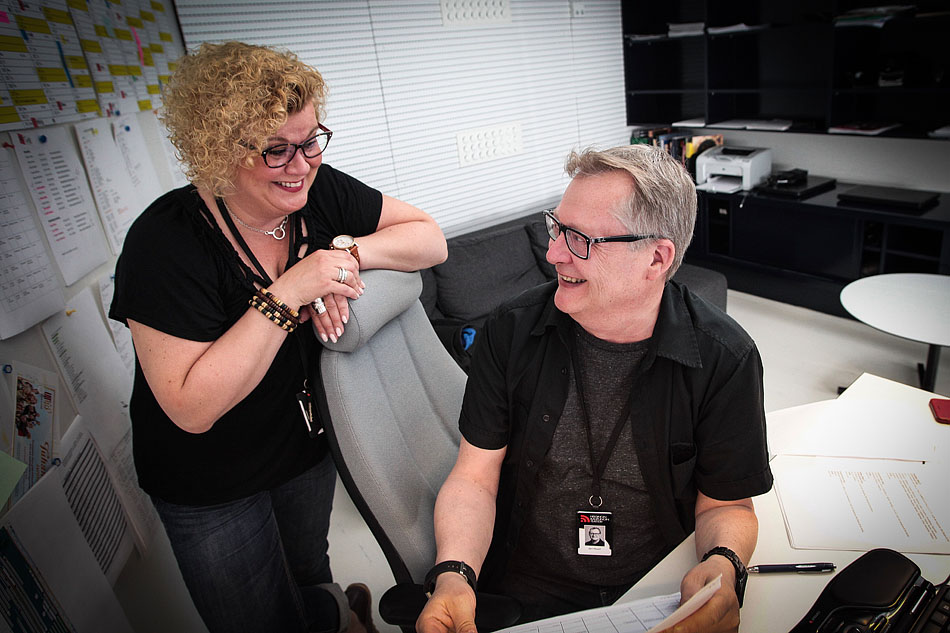
As production planner, Fluuri focuses on the big picture and long-term plans.
“I schedule the performances on the different stages and make sure our in-house actors are allocated sensibly between productions,” he explains.
Engaging and scheduling visiting performers adds another interesting dimension to the operation, and Fluuri works closely with other theatres in Southern Finland to make it all happen.
“There’s a fantastic spirit among the production planners at the other theatres. We meet regularly and go through our schedules together. For example, I once travelled to Tampere to ‘trade’ an actor with two other theatres. We all had our own paperwork, and then we divided up his time: this weekend for you, this one for us. The actor ended up with only Sundays off!” Fluuri laughs.
“But the actor had given us free rein and told us to sort it out!”
Detective work and a feel for people
Problem-solving skills and a logical mind. Those are the qualities a good theatre producer needs.
“I love detective work! It’s brilliant when something unusual crops up during a production and you have to get to the bottom of it,” Karetie says.
And that happens a lot in this job.
“That’s the best thing about it. Some days, if someone asked what you did at work, they simply wouldn’t believe you.”
You also need to get along with all kinds of people. Problems must be recognised and addressed quickly.
“You need a feel for people,” Fluuri continues. “We’re all different, and you have to understand how best to approach each person.”
Sometimes situations arise that are difficult to put into practice.
“An actor might have a matinee on one stage and an evening performance on another. Occasionally, they may even have two evening performances on different stages, but that is always a conscious decision. The actor simply takes a taxi from one venue to the other in the middle of the performance!” Fluuri explains.
Situations where an actor has to be replaced at short notice for one reason or another cause more of a headache.
It is always an exceptional situation, and decisions have to be made quickly.
“The schedules have already been agreed and they’re tight. Finding a new actor and getting them there is a challenge,” Karetie says. “It is always an exceptional situation, and decisions have to be made quickly. That adds pressure.”
If nothing unexpected happens, a producer’s work on a production ends with the premiere. For the production planner, the production remains part of the planning process right up until the final performance.
“The premiere is always an important moment. You always get a little caught up in the excitement, and every premiere is slightly nerve-racking. Even when work on the next productions is already under way, the premiere marks the end of that particular job. It’s special to see the finished production and know that your own contribution helped bring the whole thing together,” Karetie says.
“Even though I sometimes dream about going to work at the Airam light bulb factory or becoming a tram driver, I don’t think either job would offer challenges as entertaining as the ones we have here!”
Fluuri nods beside her.
“The project-based nature of the work keeps it interesting. Whenever a new production begins, you can’t wait to find out what it will bring and how it will all be done. You always get that feeling: yes, here we go again!”