The Marketing Department brings together professionals in sales, marketing, communications and advertising. Marketing strategies for productions cover everything from publicity and media planning to multichannel ticket sales, delivering a seamless audience experience and post-show marketing. The Marketing Department is also responsible for venue hire, event production and corporate partnerships. Audience engagement offers a glimpse behind the scenes, a deeper understanding of productions and theatre work, and opportunities to take part in making theatre. Workshops for schoolchildren, learning materials, backstage tours, events and theatre projects are all part of audience engagement. The aim is to make theatre accessible to as wide a range of people as possible, regardless of age or background. Helsinki City Theatre employs a Head of Audience Engagement and audience engagement practitioners, as well as project staff working in audience engagement. Production-related archive material spanning the theatre’s entire history is managed by the archivist. Their duties also include maintaining records of the artistic staff’s employment history, filming productions for the archive and digitising old recordings. The department also includes the theatre’s switchboard, staffed by the switchboard supervisor and a switchboard operator–usher.
The audience takes centre stage
When marketing a theatre production, there is no belief in smoke and mirrors. “The production itself always comes first, and the aim is to create a campaign that reflects the character of each show. It is more about directing the ‘spotlight’ to the right place and highlighting the production’s greatest strengths,” says Marketing Planner Petra Bühler.
“Theatre marketing is not just about selling,” says Marketing Planner Petra Bühler. “We spend a lot of time thinking about how we connect with people, whether here at the theatre or on social media. That is very important to us.”
One of our key goals is to lower the threshold for engaging with culture and make the theatre feel welcoming to people who are not yet regular theatregoers. Rather than buying a theatre ticket, an easier first step may be to attend a free event that offers an introduction to the theatre. Artist talks and workshops, meanwhile, give passionate theatre enthusiasts an opportunity to deepen their relationship with the art form.

This is why the theatre has an audience engagement team led by Mirja Neuvonen. “A theatre’s role can be about more than simply staging productions. I believe we also have a social responsibility to do this work and open doors in many directions. We are Helsinki City Theatre: we must be a theatre for everyone in the city—including those who would not immediately buy tickets to major musicals.”
When a genuine connection is made, audiences also become more engaged with us.
“Compared with marketing, audience engagement also has an educational dimension, but ultimately we are doing all of this for the same audience,” Bühler emphasises.
Neuvonen agrees. “Even though we do not directly calculate how many ticket buyers this generates, it certainly has an impact. When a genuine connection is made, audiences also become more engaged with us. They develop a relationship with the theatre and a sense of ownership.”
The theatre has something for everyone
The audience engagement team organises workshops, meet-the-artist and meet-the-maker events, and backstage and theatre tours. The theatre has also begun taking its work beyond its own walls, developing longer-term projects with Helsinki neighbourhoods, among others.
“Most recently, we ran the three-year Pääosassa Jakomäki project. It gave rise to theatre groups for adults, children created their own plays in drama clubs, activities were organised for older people, a touring theatre group from here performed in the area, and we made video portraits. So there was quite a range of activities,” Neuvonen says.
The projects have focused on areas of Helsinki where there are relatively few cultural activities available. They have reached groups who might otherwise never buy a theatre ticket, including immigrants and people experiencing long-term unemployment. The nationwide Taidetestaajat project is also under way, taking every eighth-grade pupil to the theatre: once nearby and once further afield.
So far, 3,100 young people have visited us…
“So far, 3,100 young people have visited us, with those travelling the furthest coming from Enontekiö,” Neuvonen says. “Many of them have never been to the theatre before.”
The audience engagement strategy identifies children and young people as its main priority. Schools and day-care centres are our most frequent partners. Neuvonen enthuses about how rewarding it is to work with young people in workshops, even if it can sometimes take a while to get going.
“When, by the end, every one of those hoodie-clad youngsters is giving it their all, it feels fantastic!”
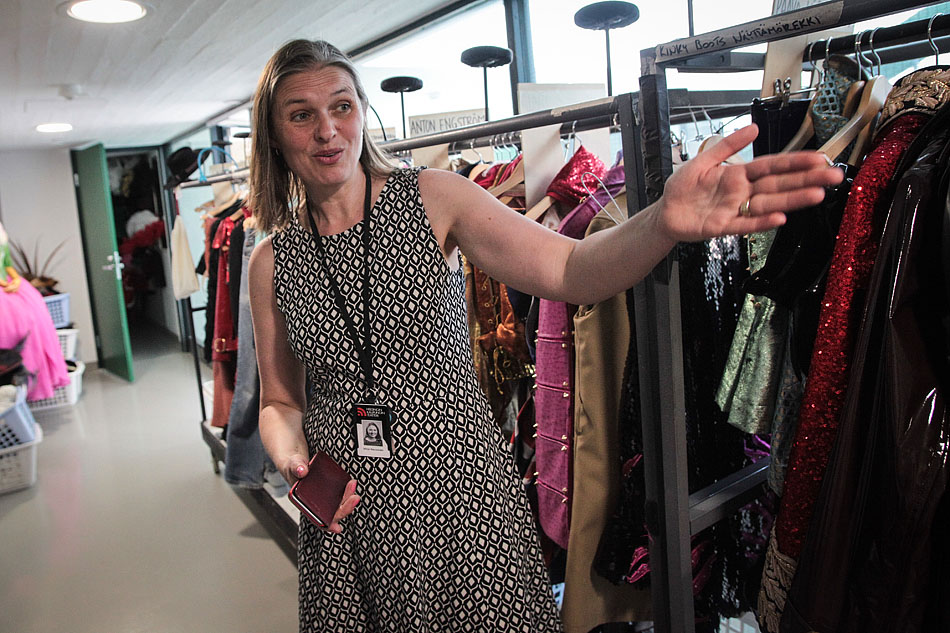
Bühler also considers it important to spark interest in theatre and offer fresh ideas to new audiences. “I hope theatre will be more firmly established in people’s minds as one of the options when they are deciding what to do in the evening or in their free time. And I hope people will not have misconceptions that theatre is somehow not for them because it is too difficult or because you have to be a certain kind of person to go.”
Experiences and emotion
A great deal of thought in theatre marketing goes into how productions are presented to audiences before the premiere. Marketing for a new production has to begin at a stage when there may still be very little known about the final result.
“This is particularly true of new writing. Marketing begins almost a year before the premiere, when no one knows what the play will ultimately become. A theatre production is not a factory-made product,” Bühler explains.
She believes successful theatre marketing gives people something they can connect with and makes them feel that this particular production could be just right for them.
“We are not marketing an essential product that can be explained through rational arguments by listing its features.”
The greatest marketing effort and investment take place when a new production goes on sale. Advance sales are especially important for large productions with many performances scheduled within a relatively short period. The aim is to get sales off to a strong start.
It is wonderful to highlight these experiences because they are genuine.
Once performances are under way, audience experiences and feedback are used in the marketing. “It is wonderful to highlight these experiences because they are genuine. They are also easy to relate to: if someone has found something meaningful in a production, it may resonate with others too.”
Marketing is also carried out with stakeholders by inviting them to see productions and helping to generate wider public conversation.
Bühler does not believe in smoke and mirrors when it comes to marketing. She stresses that the production itself always comes first. “The aim is to create a campaign that reflects the character of each show. The good thing is that we consistently produce outstanding work, so there is always plenty to talk about. It is more about directing the ‘spotlight’ to the right place and highlighting the production’s greatest strengths.”
For her, theatre’s uniqueness lies in the way audiences can experience a performance coming to life in the moment, right before their eyes. “We should do a better job of bringing that to the fore. These days, it is something quite exceptional.”