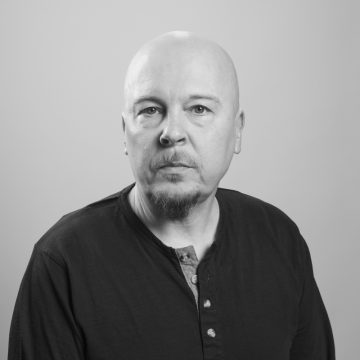
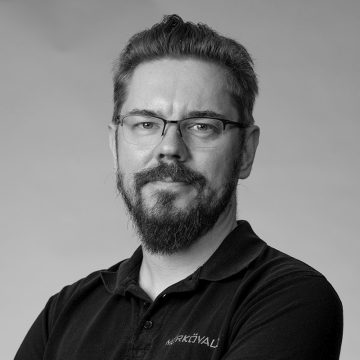
The theatre’s lighting and sound department employs lighting and sound designers, lighting masters, sound masters, lighting technicians, assistant masters, the head of the lighting and sound department, a total of about 20 people. On the Main Stage alone, there are about 200 spotlights, half of which are motorized, and 600 dimmer channels and 900 relay channels, which are controlled by GrandMA 2 light tables and the Paradigm lighting control system. There are more than 100 speakers on the big stage. Digicon SD T series soundboards are used for mixing.
Light and sound can change the mood of a theatre performance in the blink of an eye. But what are they like as tools? What can light and sound communicate? And how do you become a lighting or sound designer?
Lighting changes the mood on stage in an instant
William Iles, who is in his twenties, watched the work of lighting designers at the Stoa Cultural Centre. It was the beginning of the millennium and Iles was doing his civilian service at Stoa in the field of stage technology.
“There were a lot of contemporary dance performances visiting them, and they always had really nice lights. It made an impression.”
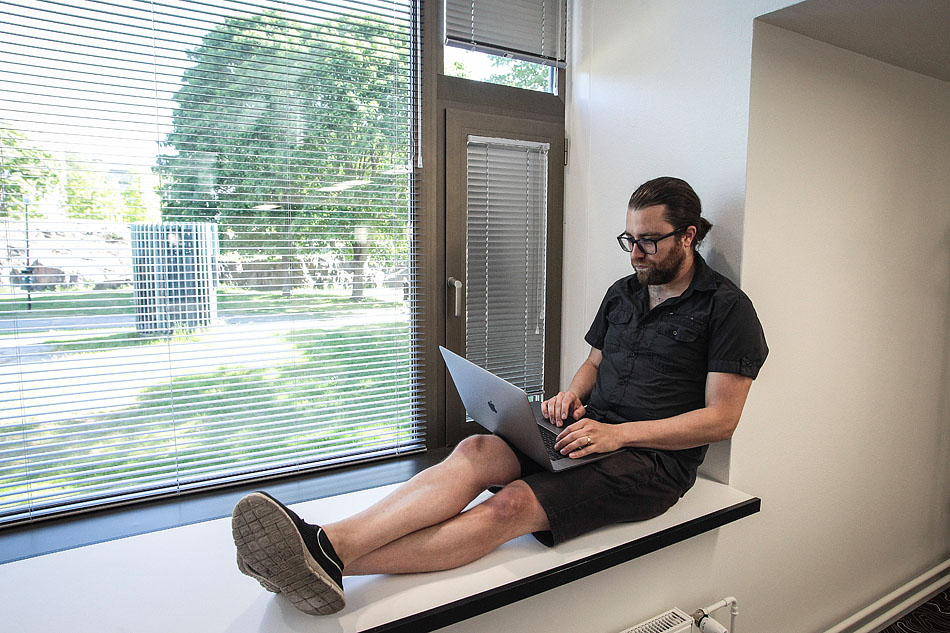
Iles, who was also a theatre enthusiast in his youth, was impressed by how quickly light could change the atmosphere on stage or the entire stage image into something completely different.
“It also felt like I got a pretty quick grasp of how to work with lights. The basic building blocks are really simple: there are different lamps and they are placed on the stage from different directions and coloured in different ways. Then it is decided from the light table which ones are on at which stage. It was understandable and interesting.”
I was quite sceptical about how independently and freely you can practice the artistic side in such a large institutional theatre. The fear has turned out to be unfounded.
After his non-military service, Iles applied for and was accepted to the Theatre Academy to study lighting design. Already in his last years of study, he worked as a freelance lighting designer in different parts of Finland: in Turku, Tampere, Kuopio and in Helsinki’s smaller theatres. Then there was an advertisement in Helsingin Sanomat for a position as a designer lighting technician at the Helsinki City Theatre.
“I was quite sceptical about how independently and freely you can pursue the artistic side in such a large institutional theatre. The fear has turned out to be unfounded.”
After a year, the title changed to lighting designer, and Iles is already in her eighth year in that position.
Light can have an impact in many ways
Contemporary dance as an art form has remained a kind of favourite child for Iles.
“It made a big impression because it was so incomprehensible and strange. I still don’t understand anything about it, but I’ve learned to accept that it just gives me an impression of something.”
In dance performances, the staging is often more sparse or suggestive, which gives the lights more space and emphasized meaning.
“Lights can be used to emphasize very different things and it has many functions. First of all, the audience usually wants to see the performers. It is the functional side of light in theatre. In addition, light communicates concrete things, such as the time of day and the weather.”
“But you can also do more abstract things with light. Even psychological things. What is the world we want to be in? What else do we want to see or not see? Why does a character rise so bright on stage? Light can also be used to tell subconscious stories,” Iles describes.
“When it comes to a new work, it is always important to get into the groove of that work and understand what the work is about. We have a lot of dialogue with the working group and other artistic designers about what we are aiming for and what kind of performance we are making with the working group.”
Variety from live gigs
Iles has visited the Finnish National Opera and “stared at” the gigs of his friends’ bands at Tavastia, as he puts it.
“It’s been fun. It’s so much about being in the moment. But I wouldn’t go to the camera to light up. It’s a whole other thing. I don’t know cameras. However, in this job, I do these things for my own eyes.”
When you work in the largest theatre house in the country with the best resources in the country, it is hard to imagine a better place within Finland’s borders. But working abroad could interest Iles at some point.
“It’s an exciting thought. But at the moment, I don’t have a huge desire to go anywhere,” he says.
Sound is also a visual element
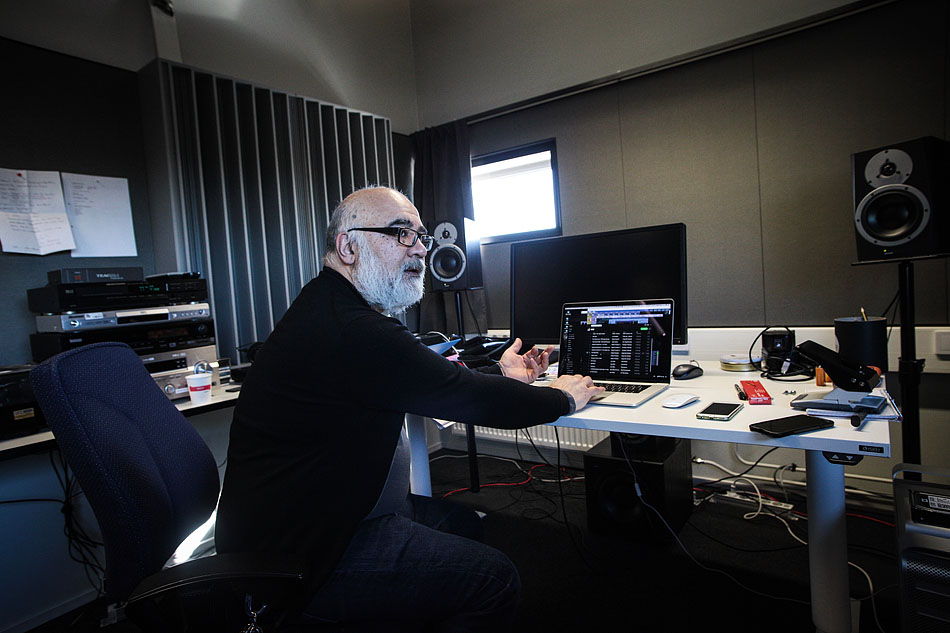
Eradj Nazimov remembers well his first production at the Helsinki City Theatre, even though a couple of decades have already passed since then.
“It was a dance performance by Jorma Uotinen . It used ready-made music from recordings and we had to be able to read from the choreography when the music begins, ends or changes. Everything was done manually. I’m very grateful to that production, because it taught me how to read choreography on stage.”
“Uotinen had a great approach to combining the visual world and music,” he praises.
Nazimov has travelled an interesting journey from the mountains of Tajikistan to become a sound designer at the Helsinki City Theatre. However, music has been with him throughout his life.
“My father was a famous singer. I’ve always missed playing. There is so much good music in the world.”
Riki Sorsa’s ‘Reggae OK’ was a big deal. Everyone was drinking!
The hobby turned into a profession. While studying at a film school in Moscow, Nazimov worked as a DJ.
“It was an interesting time. I also knew some Finnish songs well, because they were listened to in Russia in the 80s.”
“Riki Sorsa’s ‘Reggae OK’ was a big deal. Everyone was drinking!”, he laughs.
The combination of the visual world and music was also guided by the Russian television of the time.
“There were such stupid programs on TV at the time! Mostly news and the narrative was pretty faceless. We turned the sound off the TV and played music in its place. This is how we reinterpreted the programmes.”
As a mediator of something bigger?
After moving to Finland, Nazimov noticed that it was difficult to get a job in the film industry. She ended up working for a company that produces sound and concert services, which also worked for the Helsinki City Theatre. When the company’s technical director moved to work at the City Theatre, he asked Nazimov to be a sound technician. The year was 1989.
“I agreed, and I haven’t regretted it at all!”
Nazimov, who started out at the theatre as “Mickey Boy”, noticed that he had a lot of views and ideas for the realisation of the soundscape of the performances. Others noticed it and Nazimov eventually became a sound designer.
“If you compare it to the situation 20 years ago, when sound design was more about adding thunder and a doorbell to the performance, now I’m involved throughout the whole process.”
“A new production begins with a conversation with the director. You have to get into the world of the performance. But it is difficult to bring up issues related to sound on paper or even in conversations. That’s why I start my work by collecting all kinds of material related to the world of the show: pictures from Pinterest, videos, music,” he explains.
Another important discussion takes place with the set designer. The sound comes from the speakers, and each of them must have its own place in the staging.
If you compare it to the situation 20 years ago, when sound design was more about adding thunder and a doorbell to the performance, now I’m involved throughout the whole process.
“In the theatre, the use of voice is so versatile. It’s completely different from a concert, for example. We have speech, music, special effects. Everyone has to be in the right proportion. We have more than 100 speakers.”
Whenever possible, Nazimov wants all sound to be produced on stage rather than from a recording. He admires the way theatre is made and sound is used in the countries of the former Eastern Bloc, for example.
“It’s simple and ingenious. I remember seeing in Hamlet how in a duel scene there was a line of men standing behind the fighters with swords in their hands. When the battle began, they brandished their swords and created the soundscape on the stage. I think it’s much more effective than the sound coming from a tape.”
Although the scripts usually don’t say anything about the soundscape, Nazimov says that he picks up the rhythm and atmosphere when he reads. The work becomes interesting when you start talking about the performance with the director. The text begins to “live”.
“I believe in premonitions. I also give things time to happen. I try not to rush ahead of them.”
“Sometimes I look at my own performances and see how things have been done, but I can’t say why this has been done. I think it comes from somewhere higher. I’m just a broker. There is never any explanation for why things have been done a certain way. At the end, I just look at the performance and say, wow, that’s how it went!”, Nazimov says.
https://www.youtube.com/watch?v=erYM3f9mrLw
In the video, the mix of the musical is summarized from an hour to a minute.